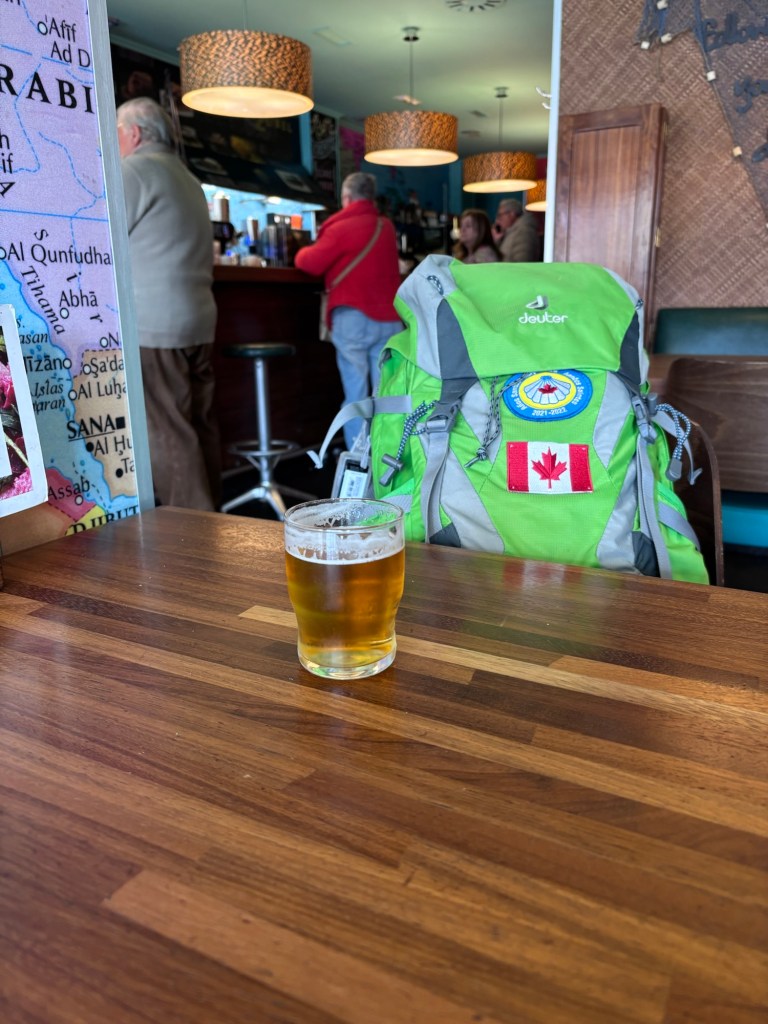
Tomorrow I fly from Vancouver to Madrid with a stopover in Toronto. For the last week I have been going to sleep 30 minutes earlier and getting up 30 minutes earlier each day to shift my circadian rhythm from Pacific time to Madrid time, a nine hours difference. I sure hope this pays off. Getting up at 3:30 a.m. Vancouver time today was not easy, especially for the night owl in me. My body feels off kilter, but I suppose this reflects the rhythm shifting in process. That, and the mental fatigue of pre-travel anxiety.
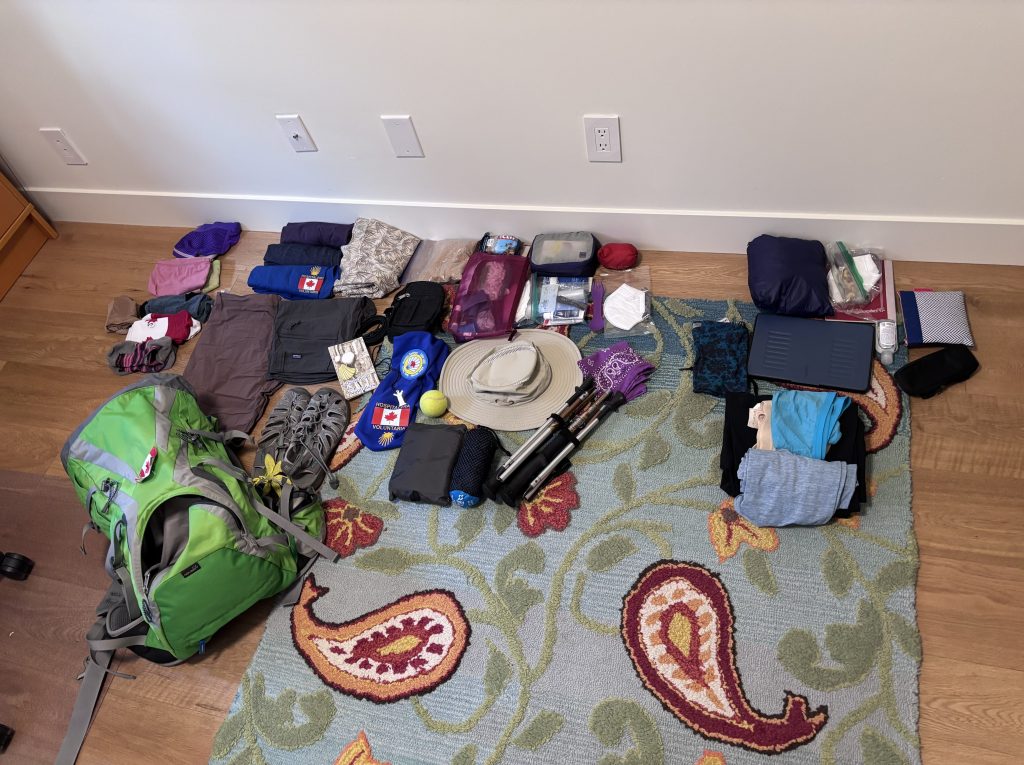
Pickle, my trusty backpack, is ready to go. Don Quixote had his Rocinante and I have my Pickle. This will be our third Camino together. I have packed, unpacked and repacked Pickle, eliminating all the would-be-nice items like a pack towel, to reduce the load. I am adopting the belief that “the Camino will provide” the things I really need along the way. And, in a pinch, my 22″x22″ bandana can get me mostly dry from a shower, which I tested today.
I arrived in Madrid surprisingly awake after my overnight flight from Toronto. Shifting my circadian rhythm to more closely match Spain’s time zone really worked. Thank you, Sheila, for working this schedule out for me AND for eating dinner at (nearly) lunchtime with me.
Getting into the city from Madrid’s Adolfo Suárez international airport was easy: bus #203 direct to Atocha train station, which put me within a 15 minute walk to my quaint little pension for the night. Hostal Gonzales is in the rather hip neighbourhood of Barrio de Letras, the “Literary Quarter” named for the renowned Spanish writers who lived here – Cervantes, Lope de Vega and others. Javier and his brother Angelo run the pension, which was clean, comfortable and simple – just what I needed for my 30 hours in Madrid.
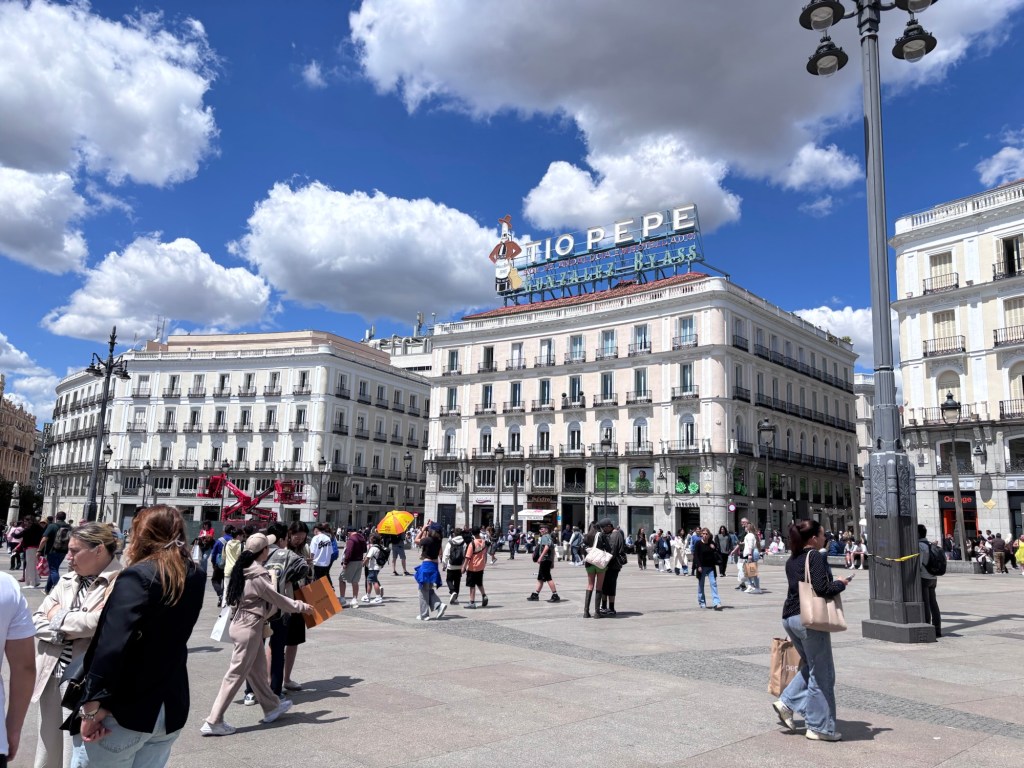
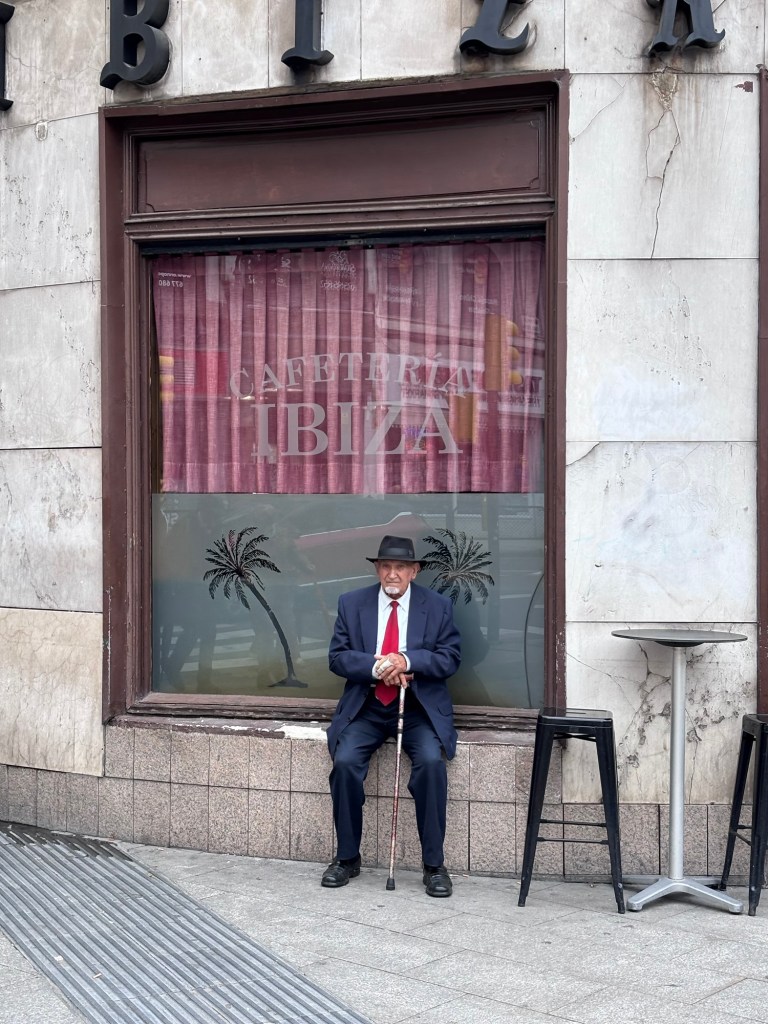
After settling Pickle into our room, I headed out to explore Madrid. This city is alive! Not in a hectic New York City kind of way, but full of the kind of energy that comes with people sitting in cafes sipping coffee or wine, talking with friends, enjoying life in an unhurried way. In the afternoon I joined a walking tour, led by Duarte, who speaks at least 4 languages. His English was impeccable. The tour covered many of the major architectural sites of Madrid: the Royal Palace, the Royal Theatre, the Cathedral City Hall, and a few plazas. We did not visit the insides of any of these buildings. On my next trip to Madrid, I will reserve time for the Prado museum and a Flamenco show.
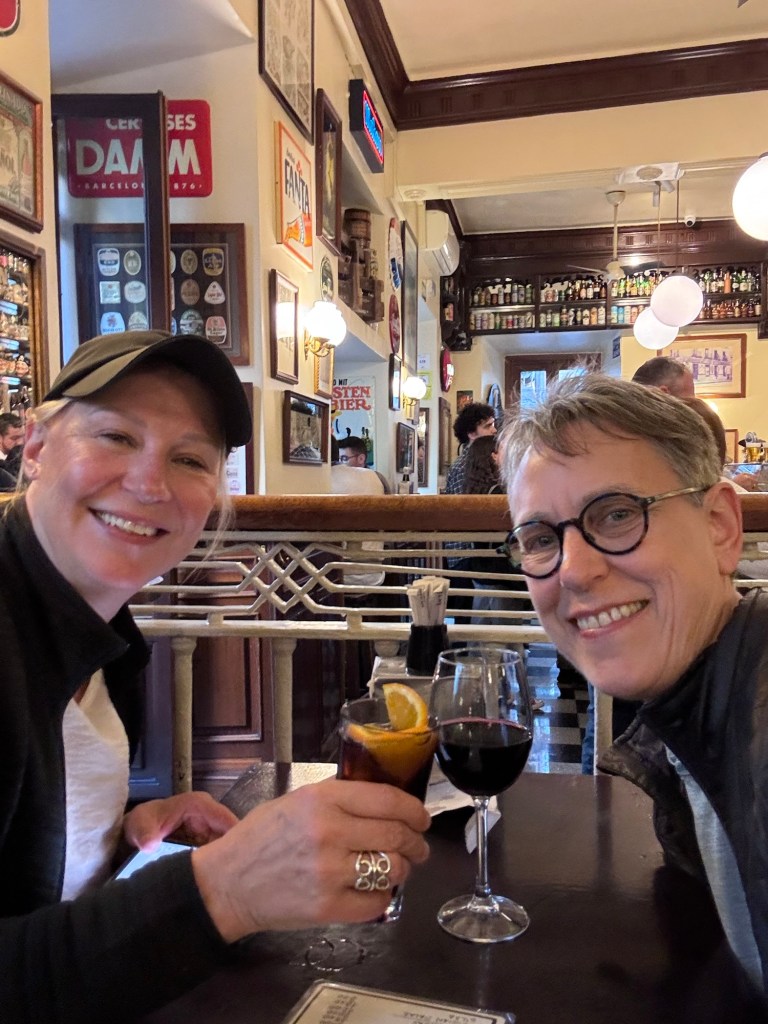
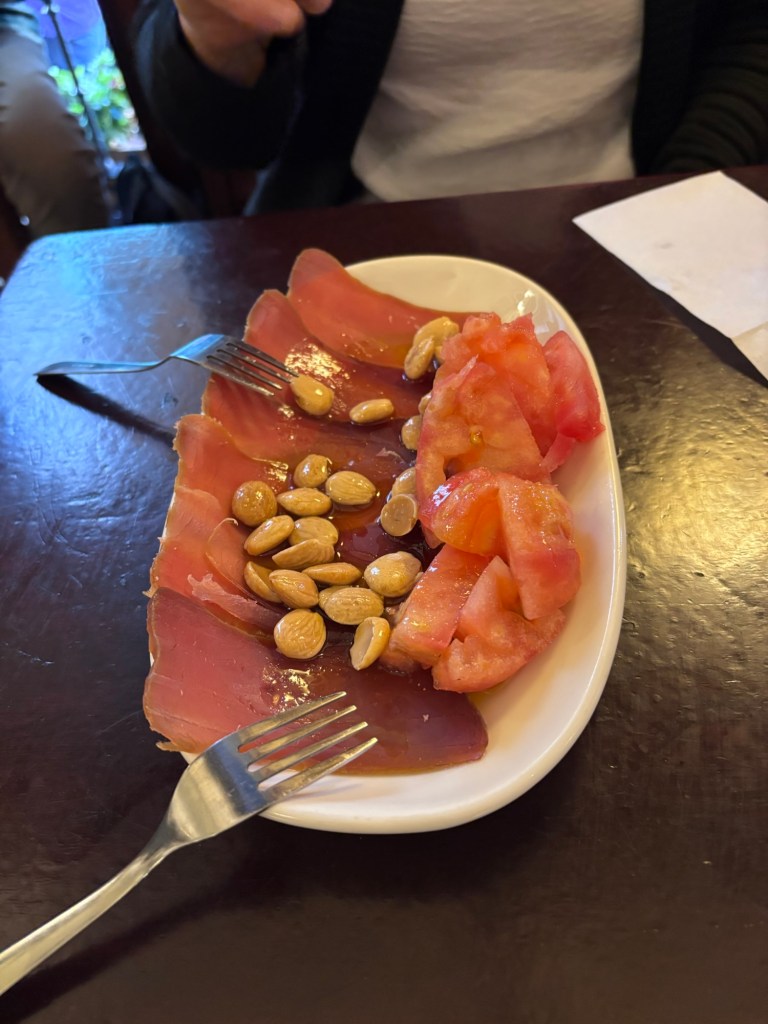
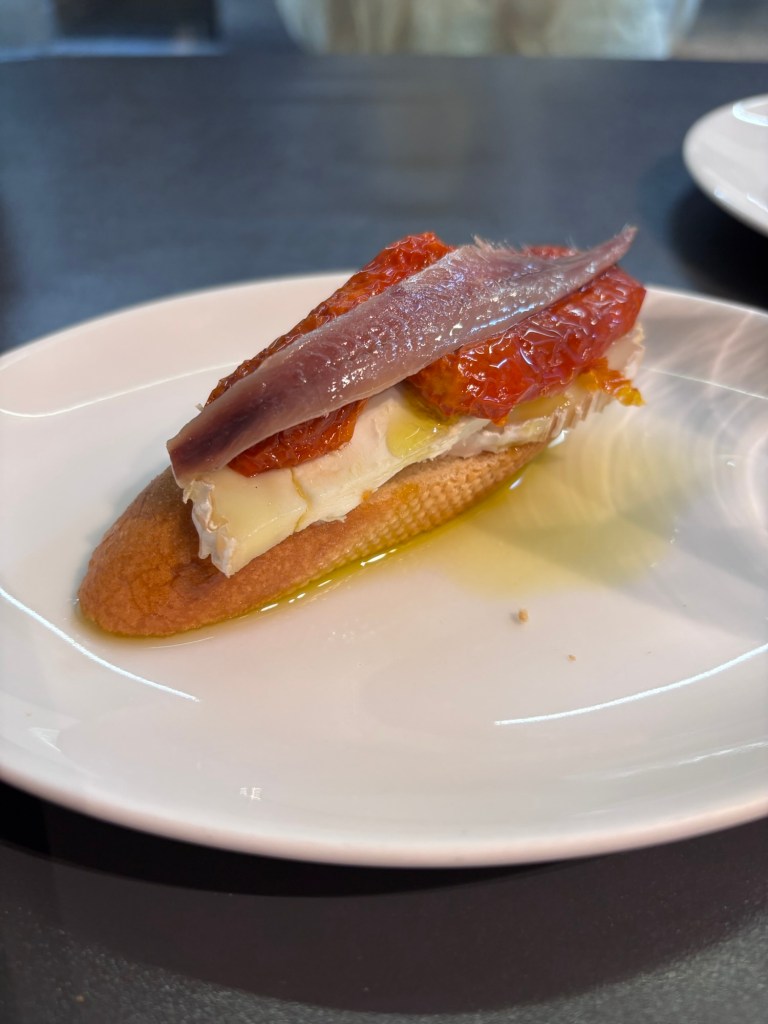
After my tour, I met my friend, Dana, and we did what the locals do: drinking and eating and chatting. Over the course of a few hours we visited three bars and sampled the local beer (in a cerveceria), wine, and vermouth, and I had my must-have Spanish happy hour drink the Tinto de verano – a mix of lemony soda and red wine over lots of ice and a slice of orange. We had a plate of dried and cured tuna that was amazing. And, who knew that Roquefort and anchovies were a good match on a piece of lightly toasted bread… paired with a Spanish red wine.
Once back in my pension, I fell fast asleep. A very good first day of this Spanish adventure.
Next up: Zaragoza.
Dana and me at La DoloresDry cured tuna with marcona almonds, tomatoes and fabulous olive oil Plaza del Sol
Dana, my traveling, buddy, and I left Madrid yesterday on an afternoon train for Zaragosa. After a rather hectic spin through Atocha station, it was a smooth and easy 90 minute ride to Zaragoza.
Why Zaragoza? I asked my friend, Chat GPT, to recommend a small city in northern Spain that is: not over-touristed, authentically Spanish, known for its cultural and historical richness, and offering good food and wine. Voila – Zaragoza! it seems that AI got this right.
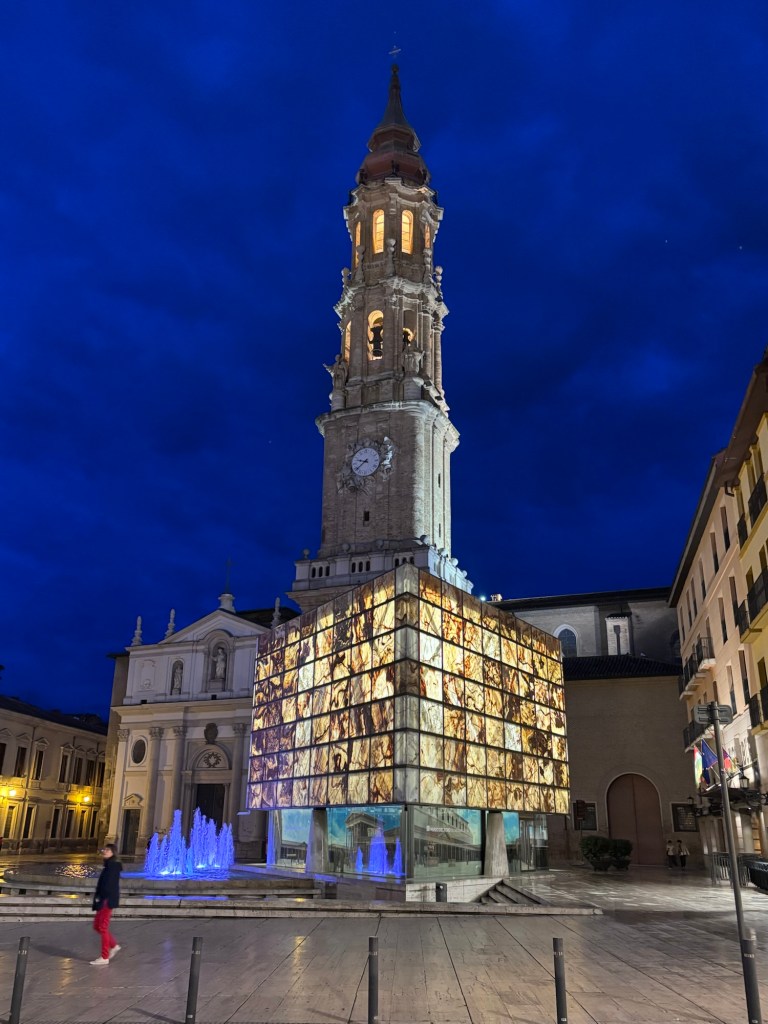
After settling into our hotel yesterday we strolled through the streets of the old town, finally finding our way to the area known as El Tubo, a meandering collection of alleys filled with tapas bars. We missed lunch and were too early for dinner, so once again we pieced together some Spanish small bites to serve as a meal: a slice of Tortilla Espanol (a potato and onion omelette), anchovies with tomato jam on bread (not to our tastes), croquettes and tomato salad. This, paired with a local white wine for Dana and a local red for me was sufficient. And the added benefit of mixing with other guests in the bar made it all the more worthwhile.
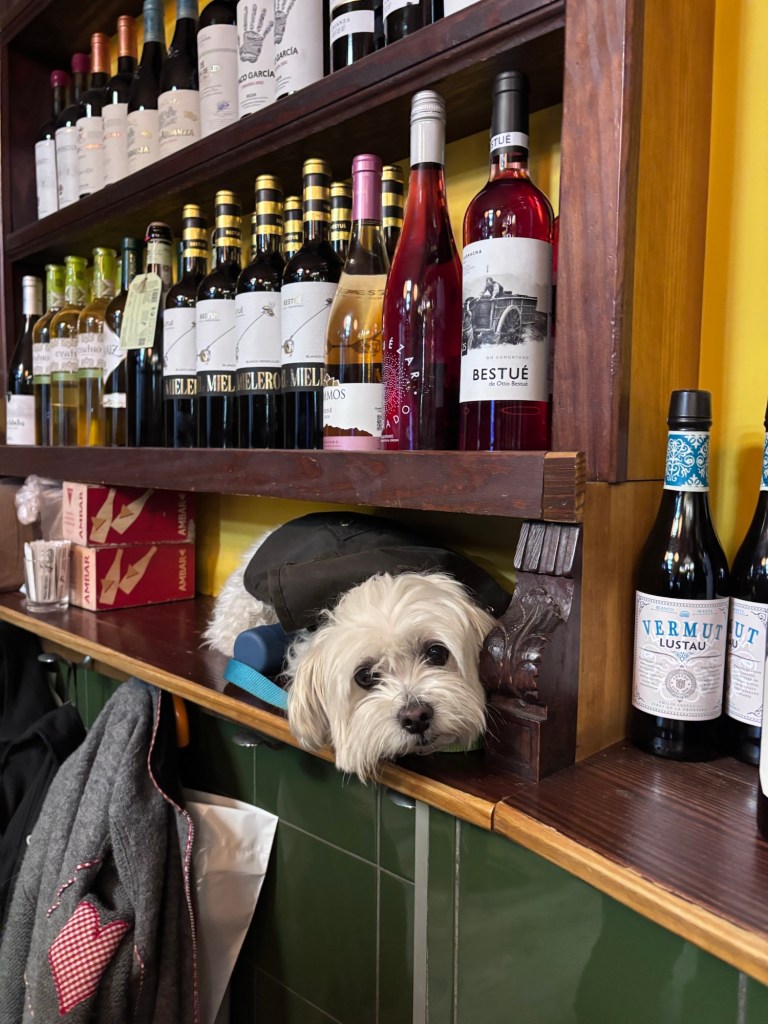
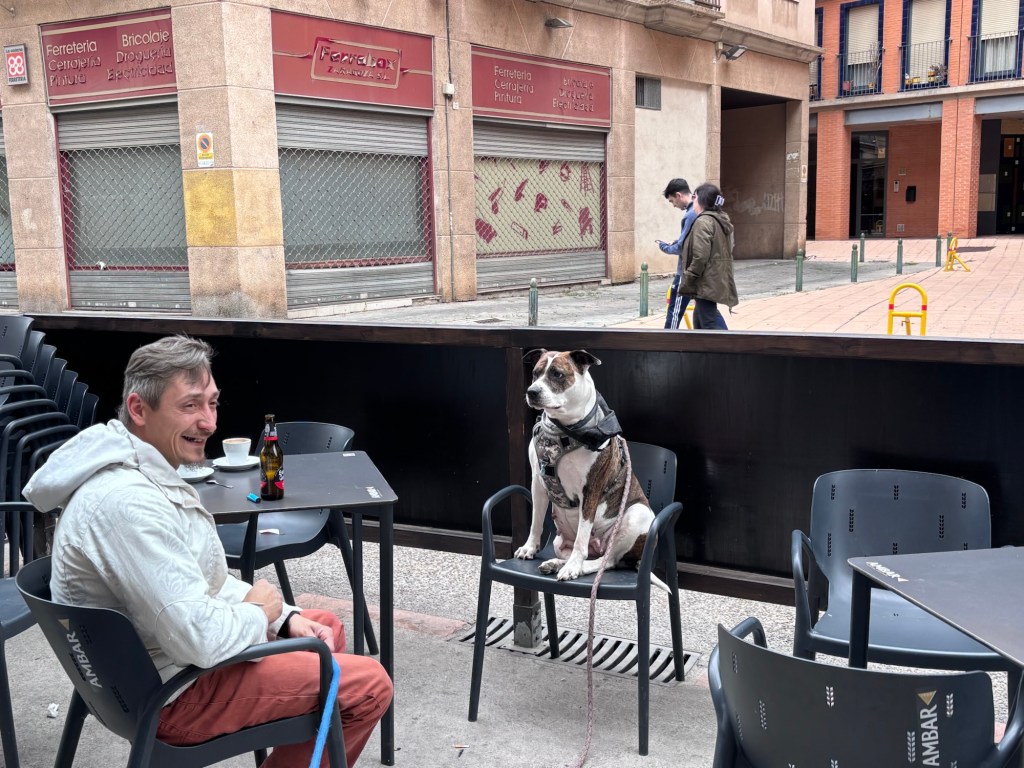
Zaragoza loves their dogs!
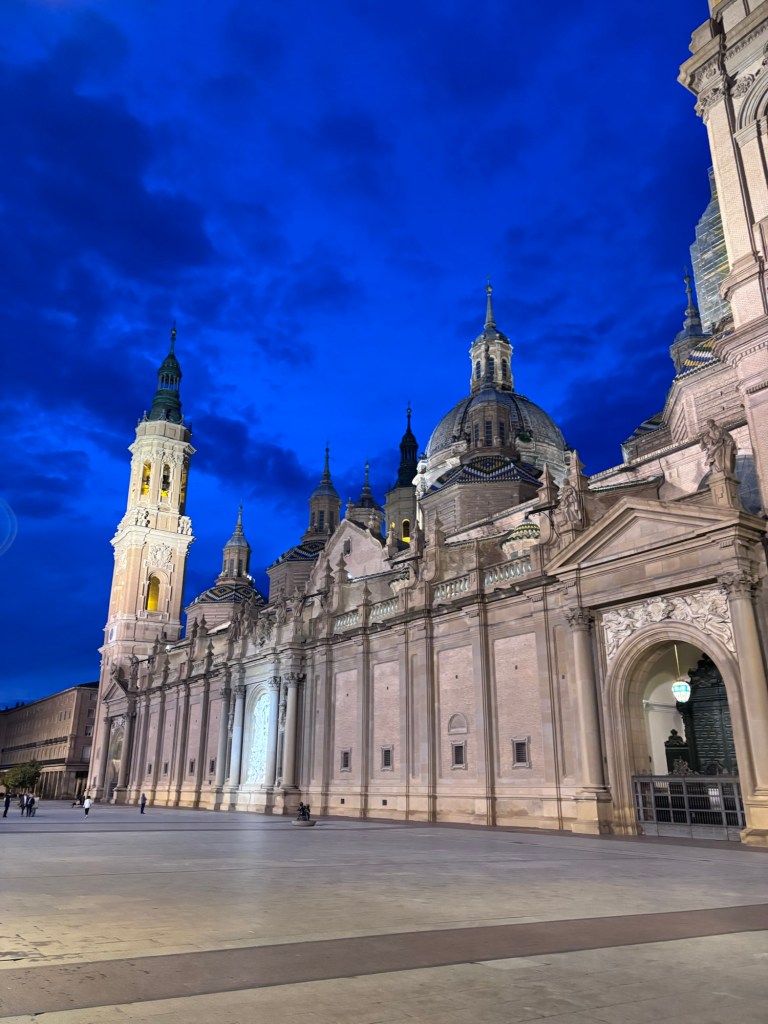
Fortified with tapas, wine and a scoop of gelato for me, we wandered into the Plaza Pilar where the indigo sky illuminated the magnificent architecture spanning a few centuries.
Monument to Goya
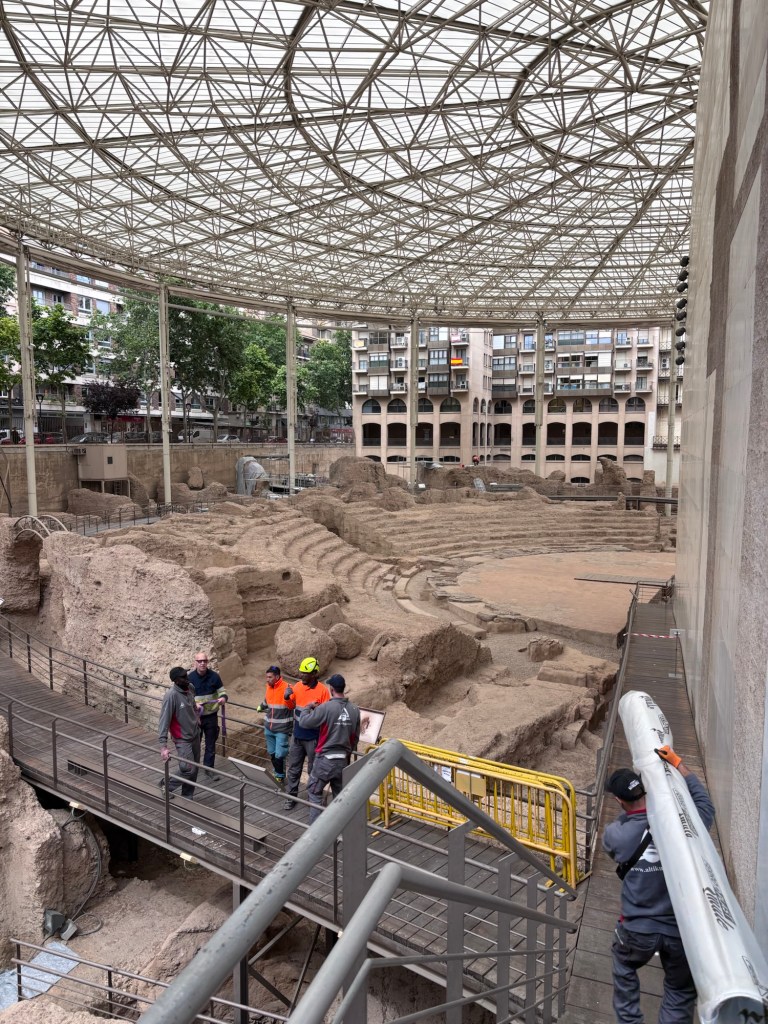
Today, we joined a walking tour, led by Pablo, a very knowledgeable and charming guide. It was more of a “standing” than a “walking” tour because we did not cover much ground. But as we stood in plazas and in front of churches and Roman ruins, I learned a lot about the history of Zaragoza. The city was named for Caesar Augustus, and if you say this aloud, you might hear the resonance of “Zaragoza”. Who knew? In 1973 when the city was excavating for a parking garage, they discovered the remains of a Roman-built coliseum. Although the city knows its heritage, this coliseum was a surprise nonetheless.
Roman coliseum still under restoration since 1973
It’s happy hour again in Zaragoza and eager to taste the local offerings once more.
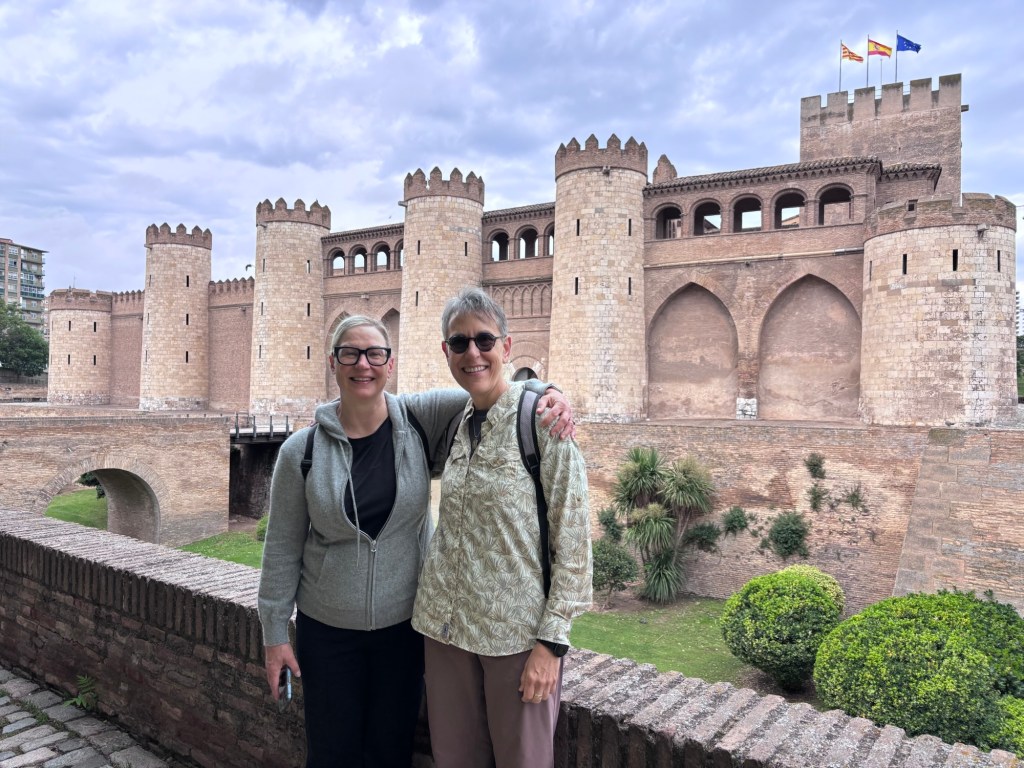
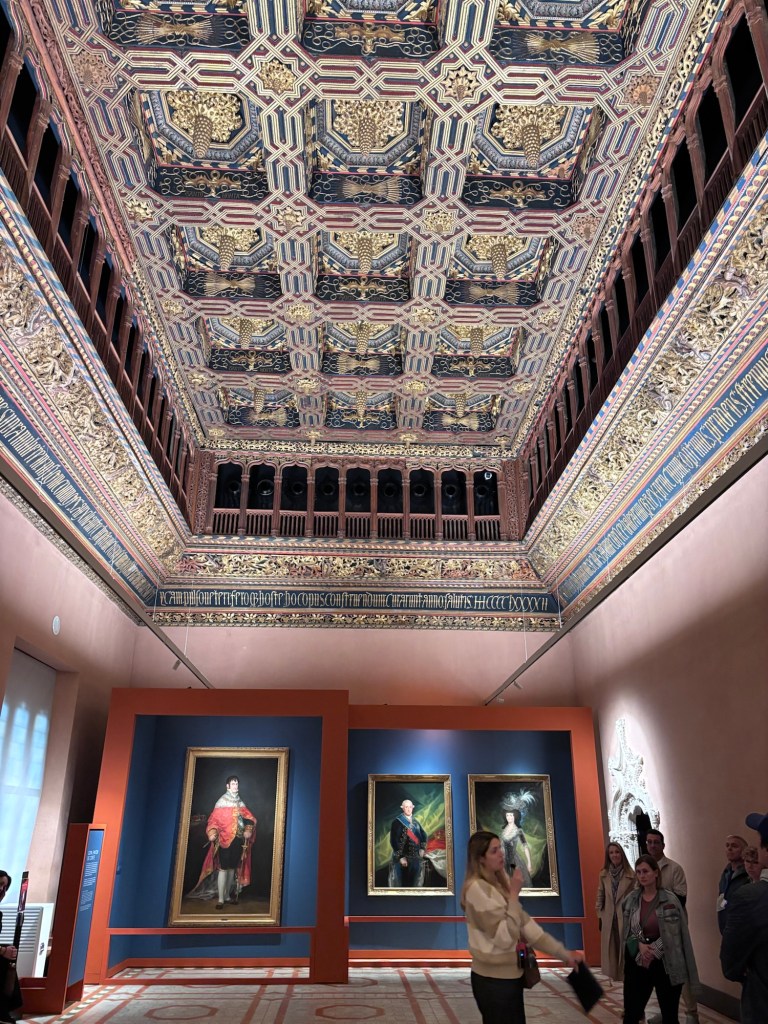
Today’s highlights included the Palace of Aljafería, the Basilica of our Lady of the Pillar, and the art of Francisco Goya. IoThe Palace was built in the 11th century for Muslim kings, and was then taken over by the Christian kings early in the next century ( in 1118), who continued to expand the palace over the next 350+ years. The Palace was declared a UNESCO world heritage site in 2001, and is one of the best preserved examples of the “Mudéjar” (a blend of Muslim and Christian) architectural styles in the world. And, today the Palace is the home of many works by Francisco Goya, who was born in a small town near Zaragoza in 1746.
Outside the Palacio de AljaferíaInside the Palacio de Aljafería with Goya
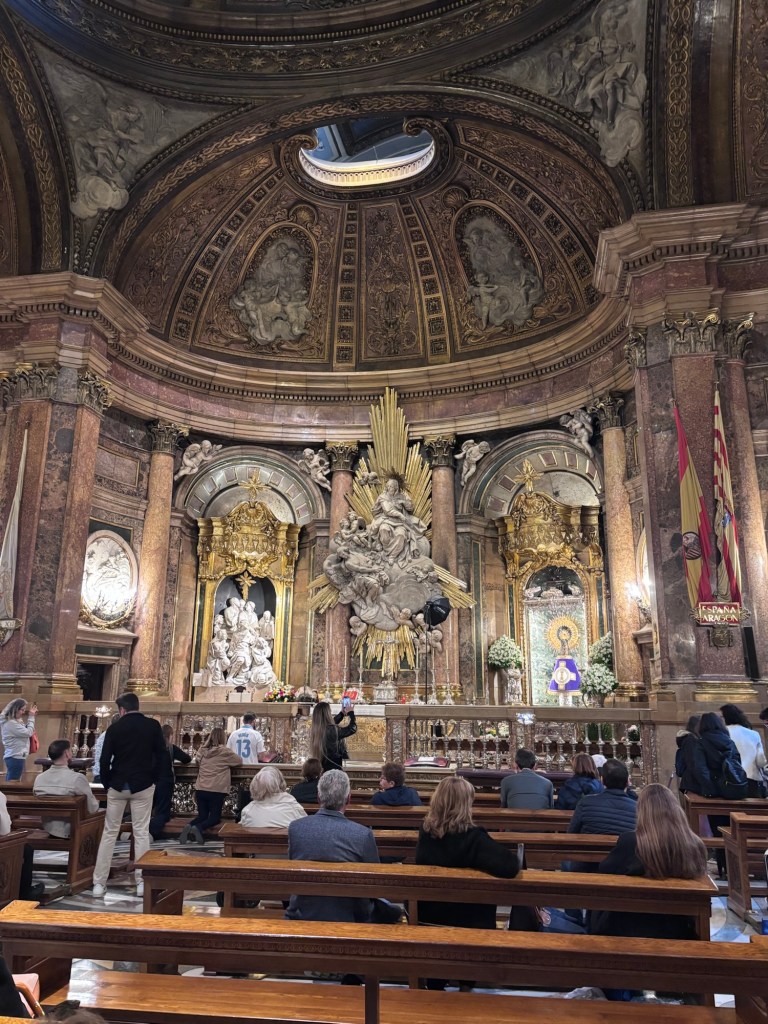
After a stop for a less-than-mediocre coffee and a too-sweet pastry, we visited the Basilica of our Lady of the Pillar. As the legend goes, back in the first century, Saint James was just about to give up on being an apostle in Spain, finding it very difficult to convert the locals to Christianity, when the Virgin Mary appeared on a pillar of marble and convinced James that “if you build it they will come.” And, so James built a church in that spot where Mary appeared – in Zaragoza. And, thus James, Saint Diego, became the patron saint of Spain. Now when the many pilgrims walk to Santiago, we might give a nod to the Virgin Mary for encouraging James to perervere.
The chapel of Our Lady of the Pillar
In addition to being awed by the amazing art today, Zaragoza once again offered up some fun people and pooch watching…
I repacked Pickle for our journey to Pamplona. How did I lose a pair of socks already? Oh well.
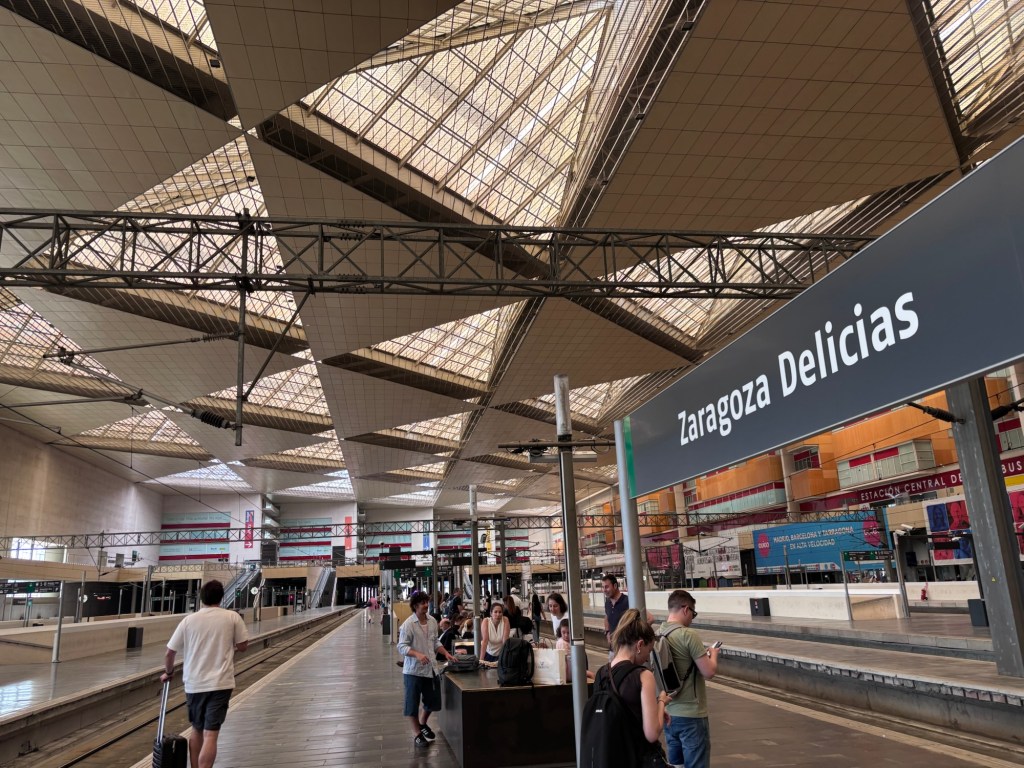
We arrived at Zaragoza’s Delicias train station an hour before our hoped-for 11:00 a.m. train only to learn that the train was “completo” – full. Oh, well.
Lucky for us, the bus station shares the same station with the trains, and there was a bus at 11:50 bound for Pamplona. So, time for a coffee and a stroll around the station.
All is good. As I type, I am watching large windmills turn slowly out the bus window. It’s a field of white windmills in an olive grove with big puffy white clouds all around. I am thinking of Don Quixote, one of my literary heroes, who “tilted at windmills” thinking them to be monstrous giants to conquer.
I am feeling grateful that in this moment I have no monsters to battle. All I have to do right now is enjoy the ride from here to there watching sketches of Spain out the window.
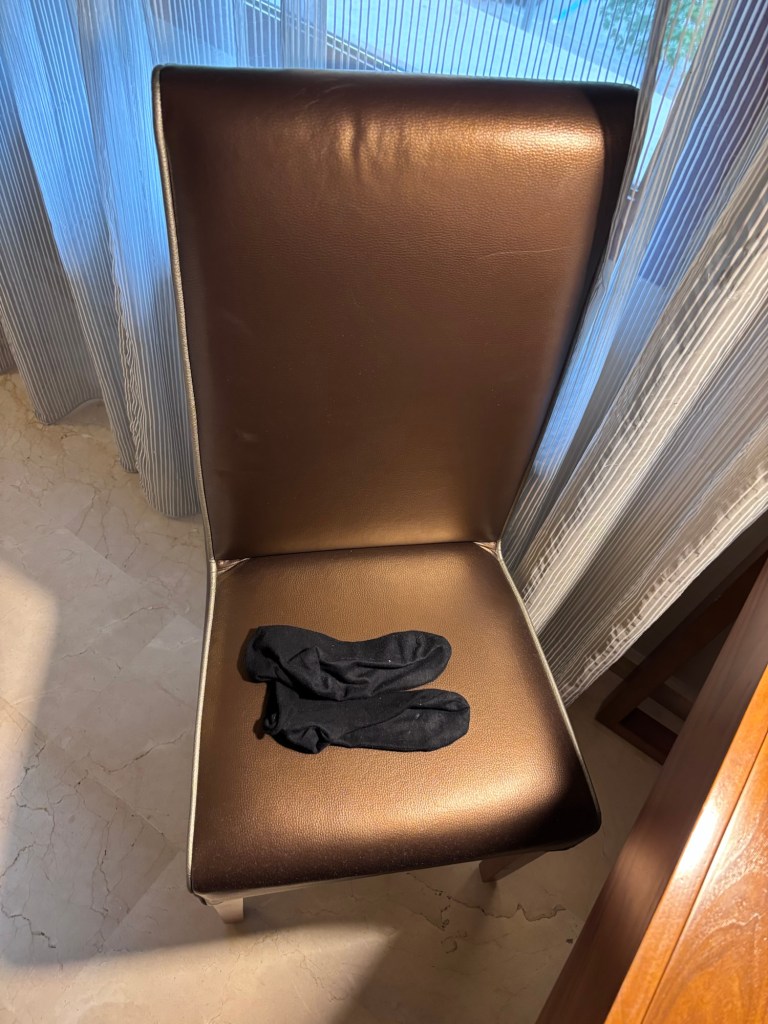
There is this saying on the Camino that “the Camino will provide.” So, those lost socks that I lamented over earlier today, well when I pulled back the chair in my hotel room in Pamplona, there was a pair of socks. Strange but true. I was simultaneously amused and grossed out. I considered washing them and walking in them because they appear to be my size. But I thought better of it and tossed the “gift” socks into the corner. And I washed my own socks instead.
Gift socks
My traveling buddy, Dana, is sick with something that resembles a cold. it’s soooo very upsetting to have this get in the way of our well-laid plans. Such are the curve balls that the Camino can present. It tests us. So while I am out sampling tapas and red wine (Ribera del Duero), Dana is resting, hoping to fend off this illness. We are hatching a Plan B, which most likely means I will be walking alone tomorrow.
The skies in Pamplona are about to erupt with rain showers, so perhaps another glass of wine and some anchovies on toast to wait this out.
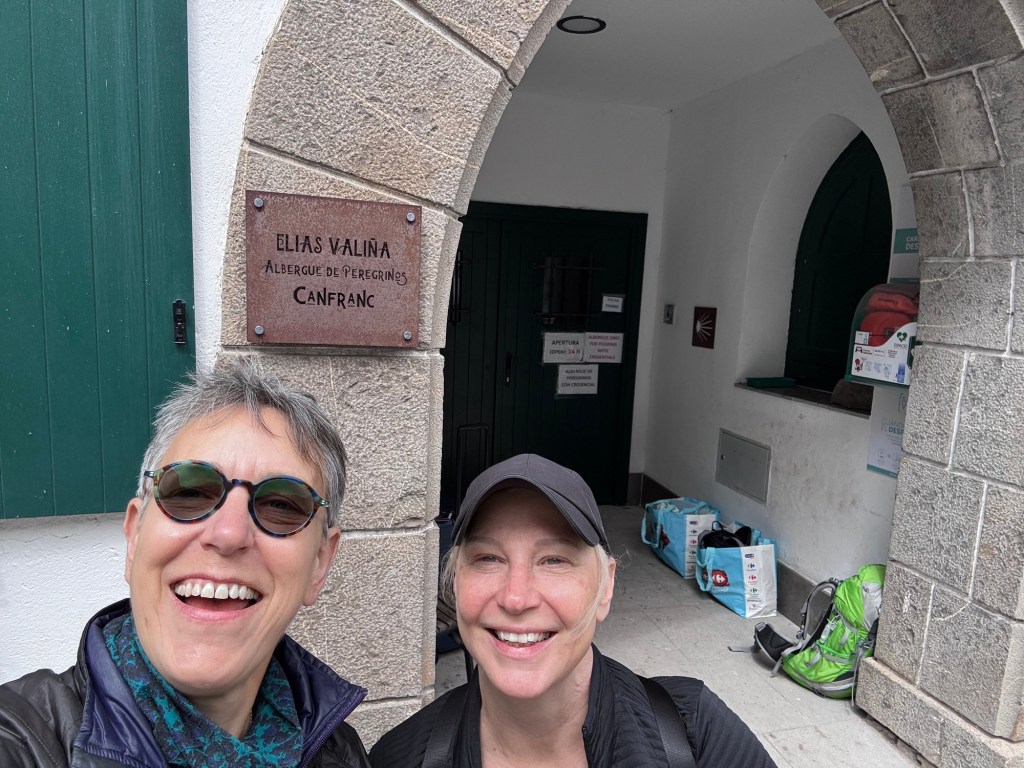
My Camino buddy, Dana, sadly had to stay in Pamplona today to fight off whatever illness has grabbed her. This is so very disappointing- a trip planned for over a year has been sidelined. A reminder that fate can interfere with our intentions and test our resolve. Dana is taking this in stride and plans to rest and then carry on to Canfranc where we will serve together as volunteer hospitaleras (hosts) in an albergue there. Watch this space for stories on all the interesting Pilgrims we meet in Canfranc.
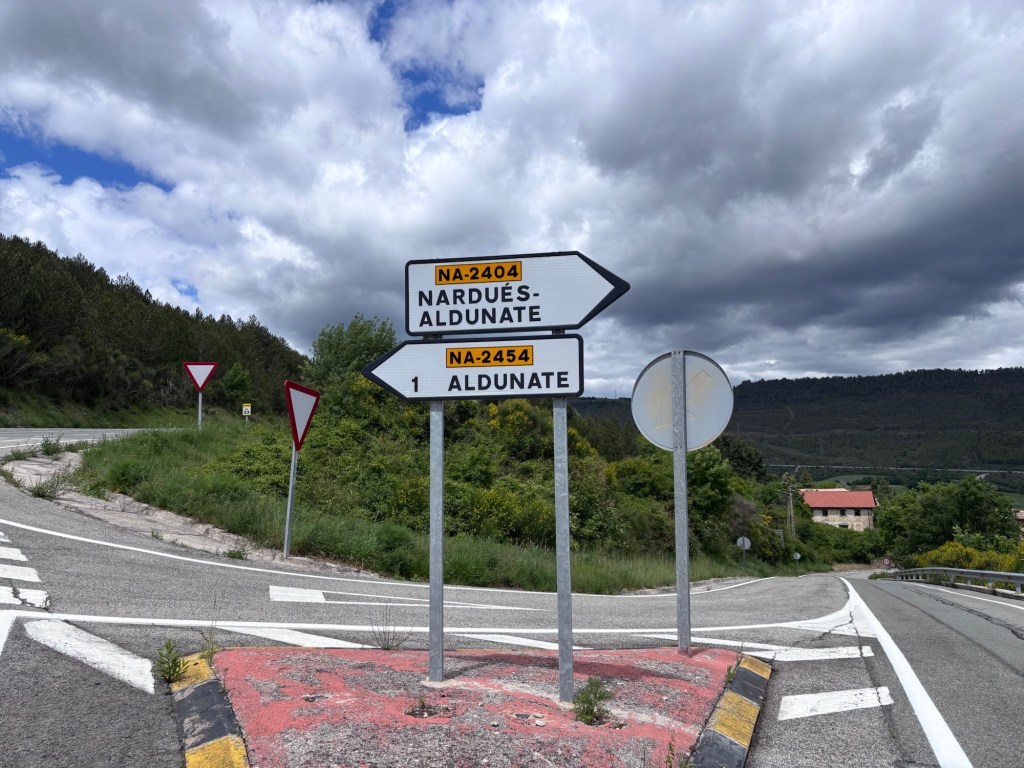
So, I walked this first leg of our mini Camino solo, starting with a bus from Pamplona to Nardués – a collection of a few house, a church and a population of 13 (not kidding, I looked at the Census data). I was the only person on the bus to get off at Nardués, where there was was not even a bus stop. I exited onto the side of a country road, and asked myself “where the hell am I and I what have o done?”
My landing in Nardués
And then this angel appeared, saving me from heading in the wrong direction from the random corner where I stood. Miracles do happen on the Camino of you make space for them. Constantin, as I would later learn to be his name, was walking up the hill as I was scratching my head and wondering which way to go. “Buen Camino” I said, to which he replied in kind. Constantin was traveling east to west on the Camino Aragones (as most do, in the direction of Santiago), and I was heading east to Canfranc. We walked awhile together so that Constantin could rejoin the traditional Aragones (he had taken a detour to see a gorge). Constantin told me he was originally from Romania but living in Strasbourg France. I said, that once upon a time I taught international law in Iasi, Romania, to which he replied, “I’m from Iasi and I went to law school there.” What are the odds? Constantin was the only other person I saw the entire day of my 5 hour walk.
Constantin, my Camino angel
The Camino Aragones is a little known route that runs nearly parallel and south of the Camino Frances, the route that most people refer to as THE Camino. In fact there are many Caminos to Santiago, and to Rome and elsewhere. The Aragones begins in Somport in France and heads west to Santiago, through Canfranc and joins the Camino Frances at Puenta La Reina. It’s a 170 km trek, but I will do just a portion of it, west to east, about 120 km, as time will tell. Today’s walk was harder than I expected, in part because at times I was not sure I was on the trail, I was alone, and a wee bit nervous. A pair of nesting pheasants scared the b-Jesus out of me while in a trance like cadence. The Aragones is a notably quiet trail: few cars, very few pilgrims, few villages, and certainly no cities along the way. As I walked today, I found myself talking out loud to keep myself company. I didn’t want to spoil the quiet or miss something by tuning out with a podcast or music, and even if I did I could not risk draining my phone battery. And it was a long day. My hamstrings ache and once again, my pack is heavier that it ought to be – in spite of my best efforts at minimalism.
After settling Pickle and me into our austere lodging for the night, I ventured into the centre of Sangüesa and waited – with a glass of wine – for the restaurants to begin serving food at 8:00 pm. Eventually I had a hamburger and a plate of French fries and refuelled for another day on the Camino.
Today’s walk tested me. It took longer than I anticipated and the town that I had relied on for a refueling spot was closed. And I mean, closed. Not a single store, bar, cafe, or church was open. Even the Albergue was closed. I had a banana for breakfast, and skipped coffee because none of the cafes were open when I left Sangüesa. Good thing I had three apricots and a power bar to serve as lunch. By the time I reached Ruesta – 8 hours later – I was out of water and very hungry.
The terrain was a lot of UP and DOWN. After leaving the town that was closed, I walked about 2 hours up, followed by about 3 hours down. And when I was not climbing, I was bushwhacking through narrow pathways which included wild rose bushes (ouch).
Thankfully the weather gods were with me. The big puffy clouds held onto their rain.
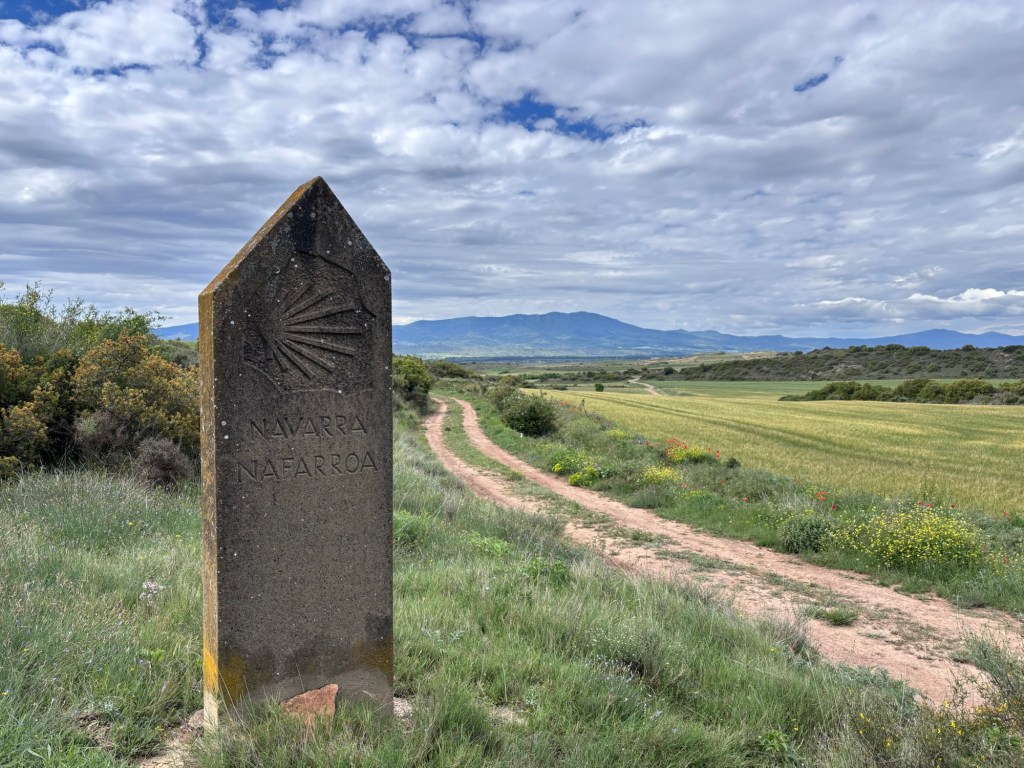
The border of Navarre and Aragon
I encountered 7 other pilgrims today on my walk – a Dutch woman on her e-bike who had ridden all the way from Holland, a German couple, one Spanish guy from Barcelona, and three French men who tried to shame me for being Canadian and not being able to speak French. The fellow pilgrims were all a bit amused that I was waking in the “wrong” direction to Santiago. So I had to explain to them that I was not lost, just on my way to a volunteer gig. Walking to work.
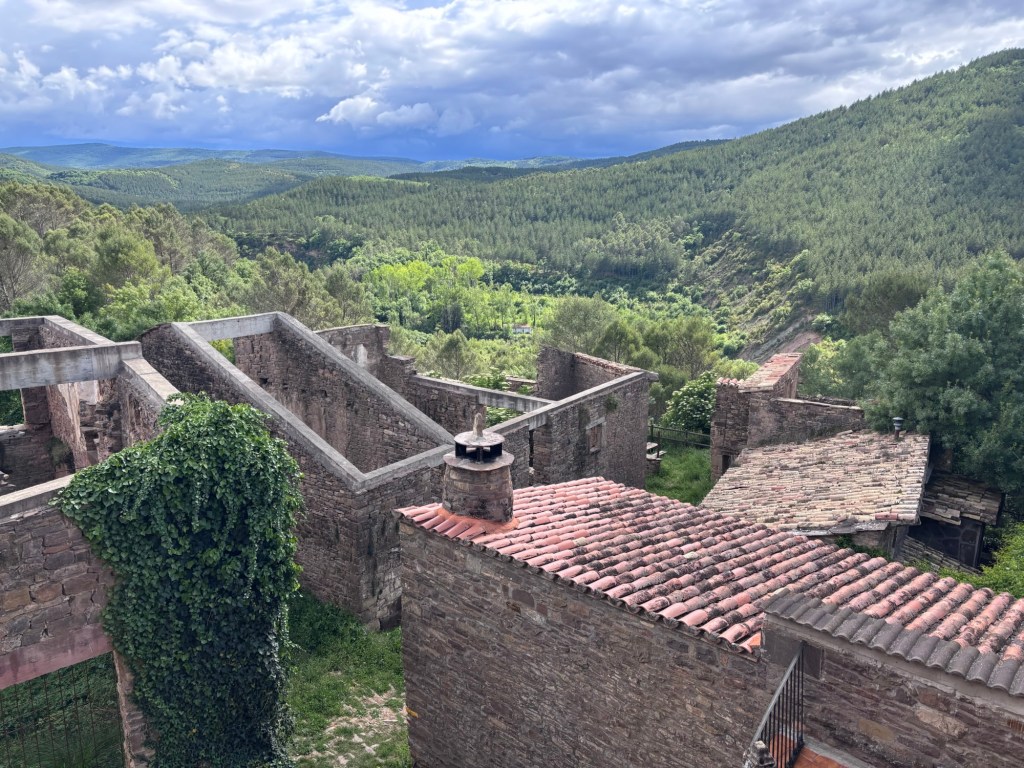
At last, I reached Ruesta, an abandoned village with the remnants of a Muslim castle. And in the middle of the ruins sits an albergue where I will sleep tonight. For 21 extra euros I also had dinner and will have breakfast tomorrow morning, which is a very good thing because there is nothing else in this town that was open.
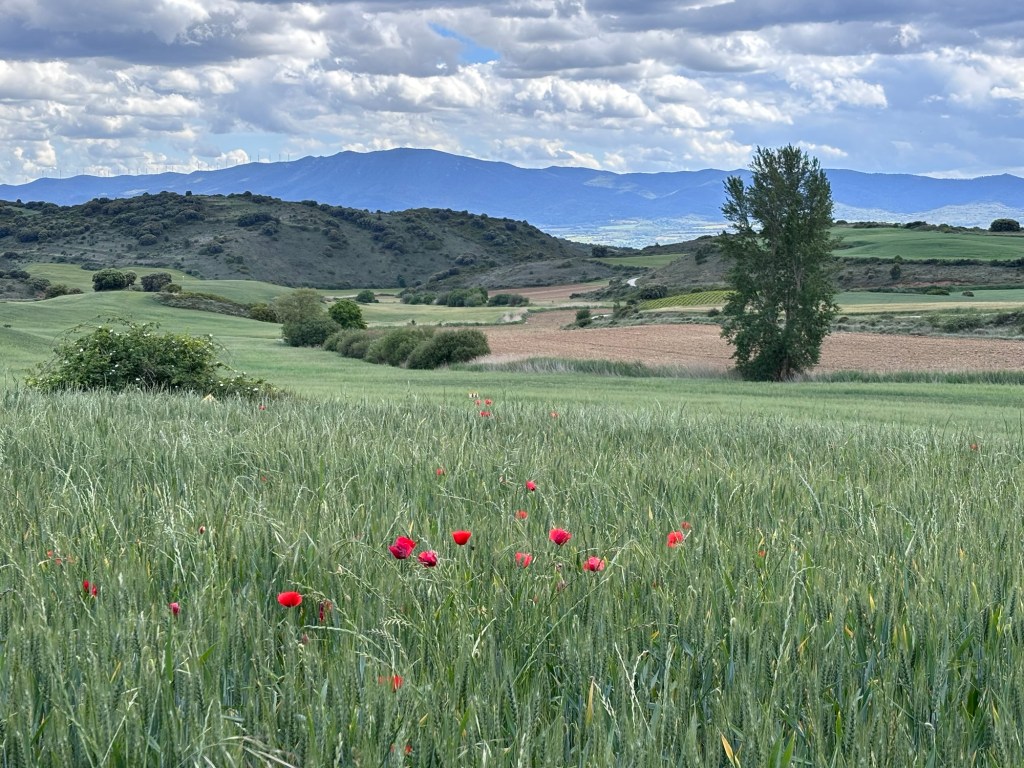
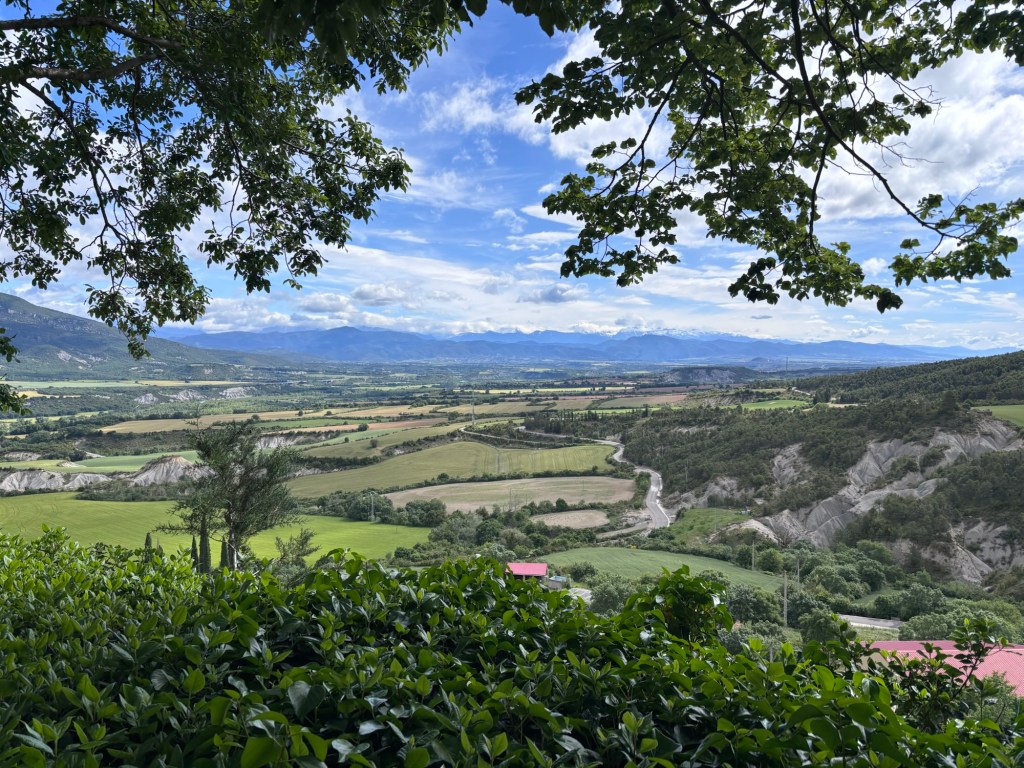
The walk today from Ruesta to Artieda was almost meditative. I say “almost” because I took a road rather than the pilgrims’ path today, which allowed me to be more certain that I was going in the right direction and freed me from attending so closely to my GPS. The landscape kept me company: the Pyrenees in the distance, big brooding and gray clouds with dappled bits of baby blue sky, deep green rolling hills and green-yellow fields in the foreground. It was quite a lovely way to start the day.
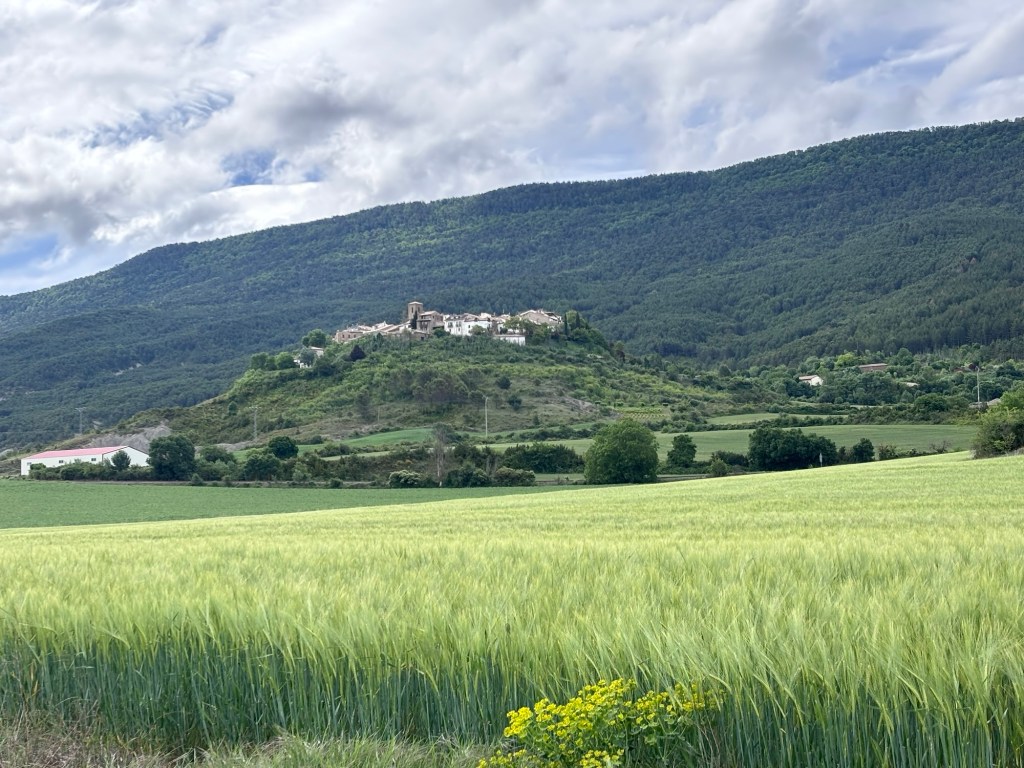
Artieda from below
After three hours, I arrived in Artieda – high up on a hill. The last hour was a steady climb up.
Artieda is a sweet little town with an albergue staffed by very friendly people. I had made a deal with myself in the morning that I would walk to Artieda, and if I could find a taxi, I would take it to Arres, my destination for the night, and if no taxi could be found, I would walk the necessary 20 kms. When I asked the friendly woman at the Albergue about a taxi, she smiled and said, “yes, we have two taxis in town.” I was relieved and at the same time, disappointed that I would not be walking the rest of the day. I was feeling really good. But my wiser self knew that it was best to be conservative and take it easy. So, I had a very nice omelette, looking out over the valley with the Pyrenees in the distance, and then took a cab with a very nice man who carefully drove me to Arres – another little town on top of a hill. I was grateful not to have walked to the top of another hill today.
Artieda from the top
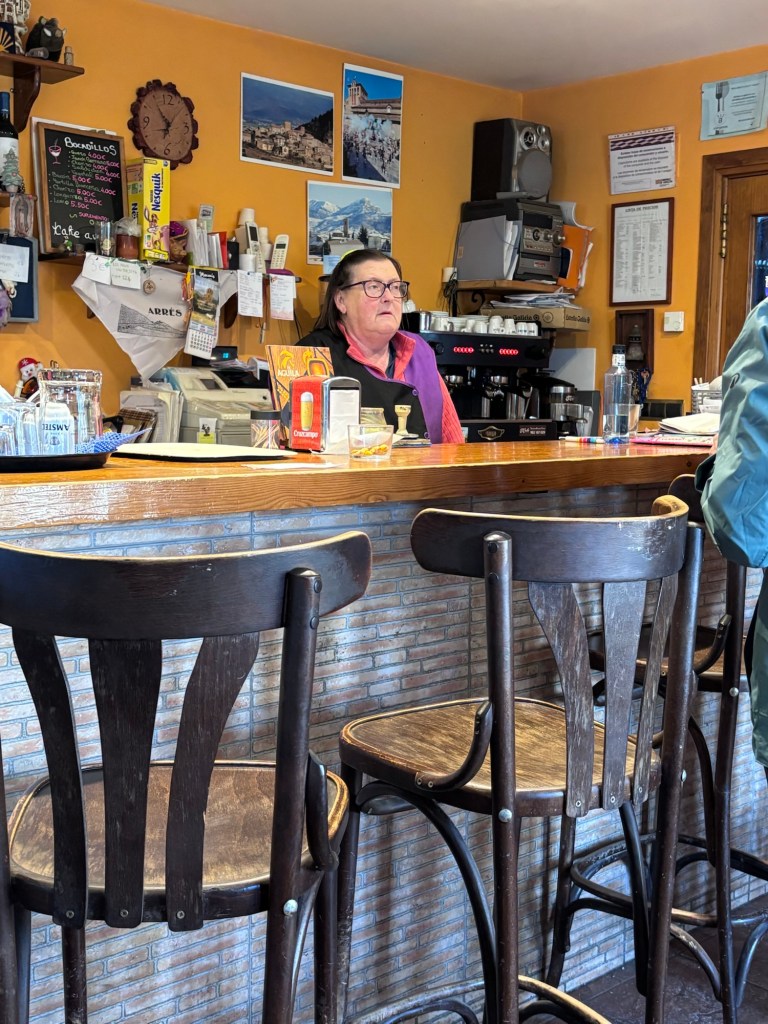
I checked into my room for the evening, did the necessary bit of hand washing some clothes, and went to the only bar in town – at my pension, the Hostal El Granero de Conde. There are only two establishments in this town – the El Granero and a donativo albergue. There are no other services in Arres. The woman who runs El Granero, Marie Luz, seems to serve as the unofficial mayor of the town. With Marie Luz behind the bar and a few locals drifting in, I was afforded a short glimpse of Arres in motion on a Wednesday afternoon.
The “Mayor” of Arres
Soon after I sat down with my beer, a couple other people came into the bar and something about them made me know they spoke English, and they did. One was from L.A. the other from Oxford in the UK. We chatted a bit and then a few other pilgrims joined, one from Germany, another from the UK and one from France. It was fun to be at a table where three different languages were being spoken. At their invitation, I decided to join the other pilgrims at their albergue for dinner.
Dinner was prepared by one of the hospitaleros, and it was delicious: pumpkin potato soup to start, a green salad with tuna, and a stuffed baked potato, and for dessert, a version of tiramisu. Another happenstance occasion that brought me joy in today’s Camino.
This was also a good and restful day for me, physically. Tomorrow will include about 22 kms and I will be ready.
Yesterday the trek from Arrés to Jaca was harder than expected. Once again I arrived in a town – Santa Cilia – and the one bar in town was closed. I had planned Santa Cilia to be lunch stop for the day, but this was not to be. So, I walked on for another 14 km. Thankfully, I had packed enough water for the day and I ate my last protein bar for lunch. After 24 km and 8.5 hours on my feet, I was happy to get to my hotel. And this was a hotel AND spa – a splurge of sorts and outside the usual Camino experience. Dana and I had planned for this as a little treat for ourselves before heading to Canfranc for our volunteer gig. I so enjoyed the jacuzzi and sauna, a perfect antidote for my aching back.
In Jaca today, we stocked up on groceries at the supermarket – 3 large bags full of provisions that would get us through the first several days at the albergue. Canfranc Pueblo, where we will volunteer for the next two weeks, has no grocery store. I also had to buy some tights to wear under my thin hiking pants because Canfranc is experiencing a cold snap – it was -1 Celsius but felt like -4 with the whipping wind. And snow is predicted. Canfranc sits at the base of the Pyrenees, so this is not entirely surprising, but I had not prepared for winter weather. I really wish I had packed some gloves.
I had originally planned to walk from Jaca to Canfranc, but adjusted my itinerary to accommodate the procurement needs for the albergue that seemed important. Sometime within the next few days, I will take the bus to Jaca and walk back to Canfranc Pueblo to complete my Camino Aragones. It promises to be a lovely 20 km walk.
Once at the albergue today, we met Al and Liz, the current hospitaleros, who oriented us to the workings of the albergue: showing us where to find supplies, how to work the washing machine and dryer, how to check folks in, how to manage the books. This albergue – Elias Valiña – is a “donativo,” which means that people who stay here pay what they can. But only Pilgrims with their Camino “credencials” who arrive by foot or bicycle are eligible to stay. This is not a place for the Camino tourist. We have just one Pilgrim staying with us tonight – someone from Germany who crossed over the Pyrenees, through snowy conditions, from France. She was appreciative of a warm shower and a cozy place to rest.
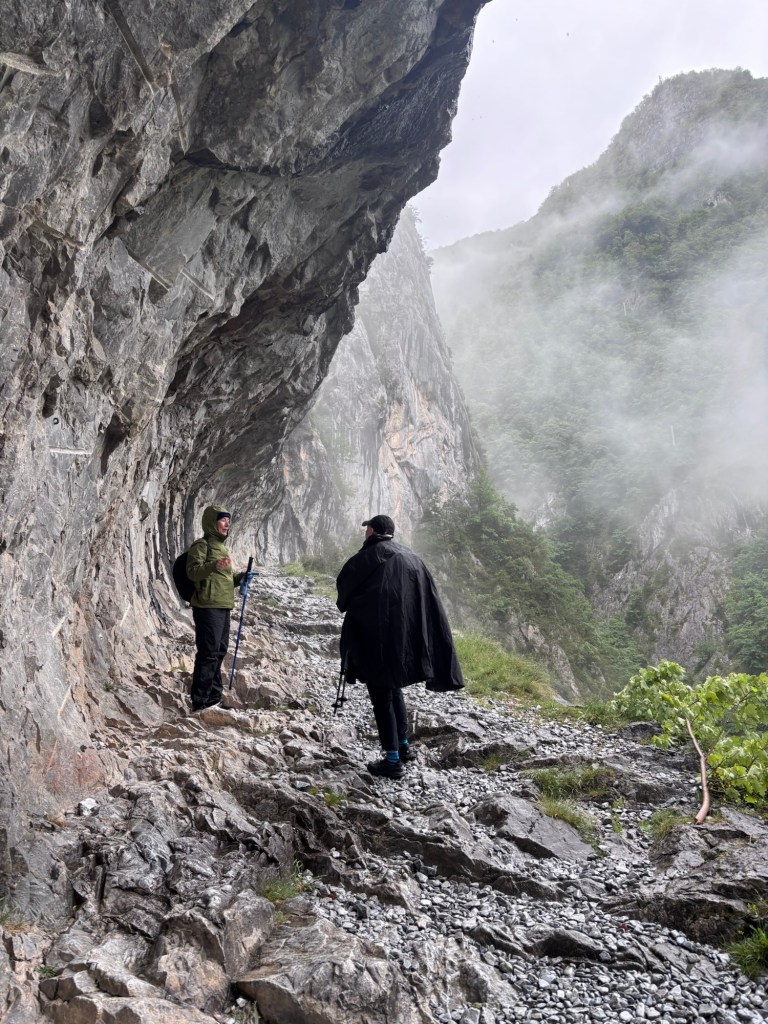
The hospitaleros who have been taking care of the Canfranc albergue before us – Alan and Liz – are seasoned and adventurous travelers. Last night they mentioned a nearby walk that they were keen to explore: the Chemin de la Mâture, which is just over the border in France. Seeing the photos of this path, cut into the Pyrenees overlooking a winding river and a castle, I said “I’m in; let’s go.” And so we did. At 8 AM this morning the one and only taxi driver in Canfranc, Miguel, picked us up in his rough and ready car and off we drove 30 minutes into France.
As we drove into the mountains with Miguel, the weather became more daunting – fog and rain and cold. We could see fresh snow in the mountains above. Nonetheless, we get out of the car, put on our rain gear unfolded our hiking poles and off we went. The effort was worth it. The views from the cliffs were spectacular. The sharp rock edges cutting the sky into pieces, with fog filling in the gaps. This path is part of a long distance trail that runs from the Pyrenees to the Mediterranean Sea, This segment was created in the late 1700s as a timber road to carry lumber to make masts for the French Navy, hence the name which literally means the “mast road.”
We turned around after an hour or so, giving in to the fog that we met as we climbed higher, and retraced our steps down the rocky path to Etsaut, where we caught a bus back to Canfranc.
On the Chemin de la Mâture
We were back at the albergue in time to welcome in today’s pilgrims, 13 in total, plus Al and Liz. This is the most pilgrims that Al had seen since the beginning of May. The Camino season has begun.
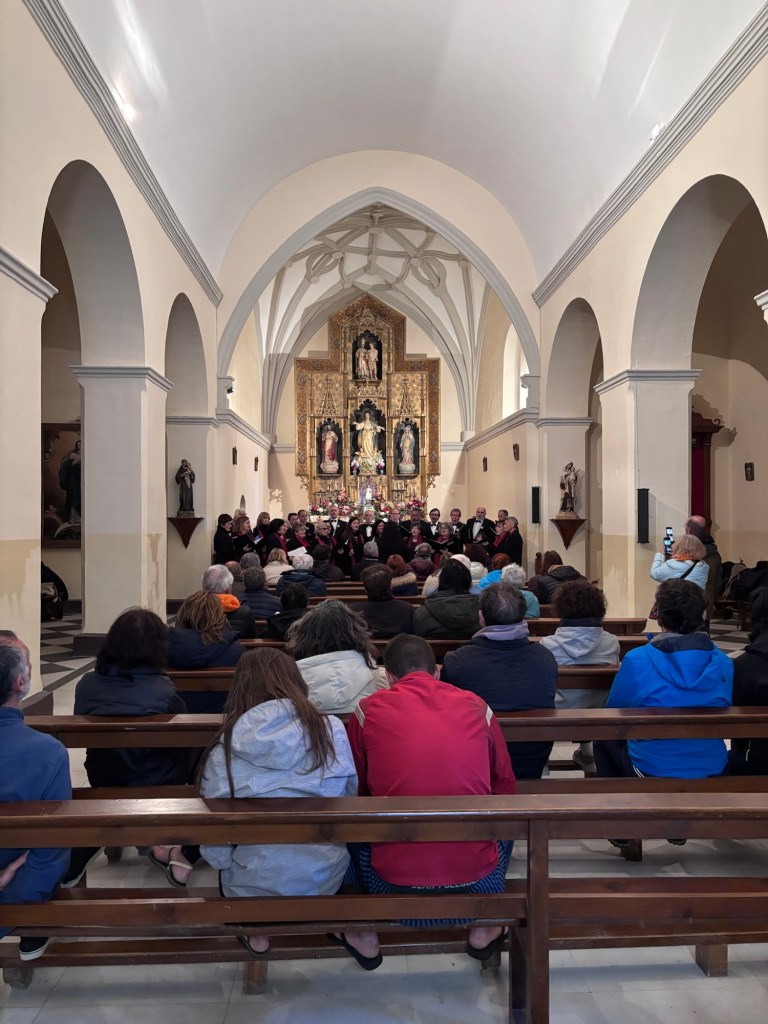
We had an early dinner. And at 7:00 pm the tiny little church across the street from the Albergue hosted a choral concert. It was sweet and beautiful to be a part of this community event. And the voices were heavenly. What a great start to our time in Canfranc.
For those of you who don’t know why I’m here in Spain or who’ve not read from the beginning of this blog, I’m here to be a “hospitalera,” a volunteer host, in an albergue along the Camino de Santiago. We hospitaleras are here to support the pilgrims walking a Camino – by offering them a welcoming place to rest for the night after their day of walking. Some albergues offer evening meals in addition to a bed. The albergue where I am serving – Elias Valiña in Canfranc – offers a bed, a simple breakfast and laundry. Having someone launder your clothes at the end of a day or several days of walking is really appreciated, and an unusual perk for folks walking a Camino. Our albergue does not offer a pilgrim’s meal for dinner, as some do, but we have a really nice kitchen where people can cook their own meals. That said, we have been offering Pilgrims some food at night becuase the only bar/restaurant in town is closed for two weeks. If you have not packed your own food, the only option for procuring food in Canfranc at this point is the gas station 800 m away, and their offerings are slim as you might imagine.
On our first night on the job, May 16, our albergue was nearly full, 15 of the 16 beds were taken. Once the pilgrims were out the door the next morning, I got to work laundering the bed linens. I’ve never mastered folding fitted sheets, so perhaps this is my chance. While I focused on the laundry, Dana worked on cleaning and organizing the kitchens. The albergue is now in tip-top shape. Almost.
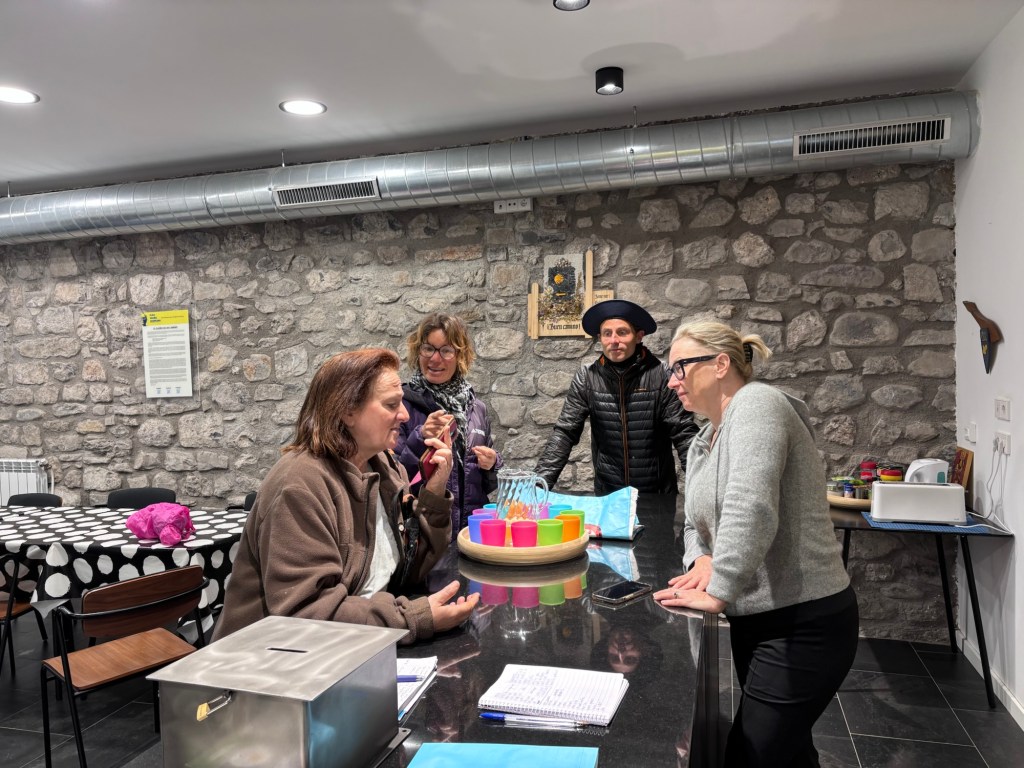
Today I took the bus to Jaca, an easy 25 minute ride, to stock up on more food and supplies for the albergue. One of the women in the village, Maria, does a supply run once a week for the heavy stuff, such as milk, juice, fruit, yogurt, cleaning supplies, and cat food – because the local cats count on us to keep them happy too. But, we need food more than once a week, so trips to Jaca for provisions are needed. Maria speaks no English and my Spanish is weak, so we rely on Google Translate to manage shopping orders and other things.
Maria using Google Translate and two Pilgrims
Jaca is a small city with a compact old town and a Romanesque cathedral first built in the 11th century, with additions made over the next few hundred years. That breath of history is mind-boggling to a North American. I did not visit the cathedral today, but I’ve put that on the list of must-see places over the next couple weeks. So while I didn’t visit any cathedrals or the Citadel today, I did take in the lay of the land for Jaca, noting a few cafés and patisseries that will satisfy my sweet tooth one day.
We hosted no pilgrims last night. This meant that I got to sleep in all the way until 7:30 a.m. – the most sleep I’ve had in two weeks. It was delicious. I got to sip my coffee rather than chug it this morning, which felt like a real treat.
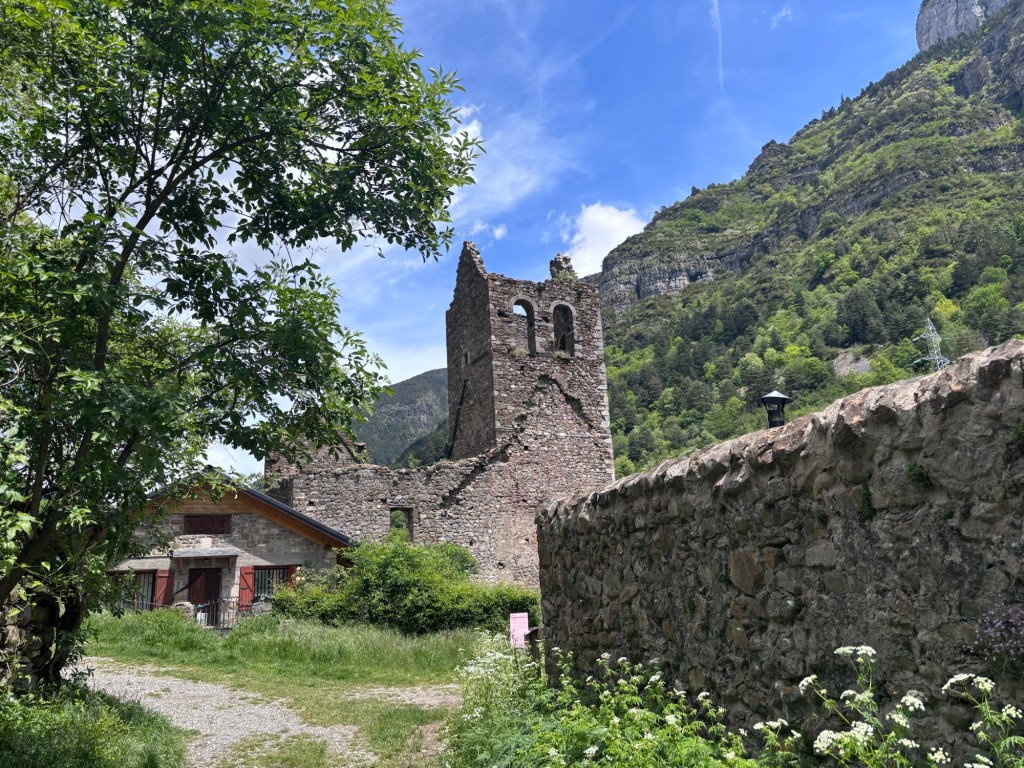
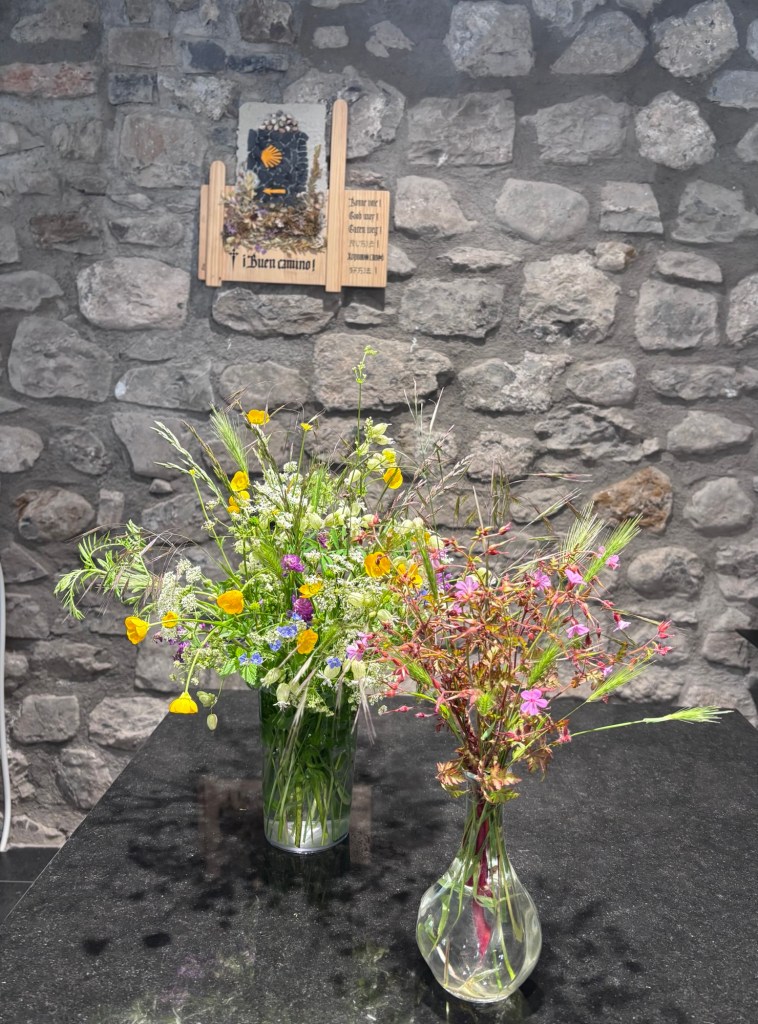
At the leisurely hour of 9:30 a.m. we were out the door and heading south to the next village on the Camino, Villanúa. There we had a picnic lunch and then walked back to Canfranc – just a 10 km round trip stroll. Along the way, we were treated ton16th century ruins, mountain views and patches of wild flowers and thyme. Dana picked some of the thyme for cooking and the flowers to decorate our Albergue.
16th century Church of the Trinidad ruinsView of the Pyrenees from Canfranc
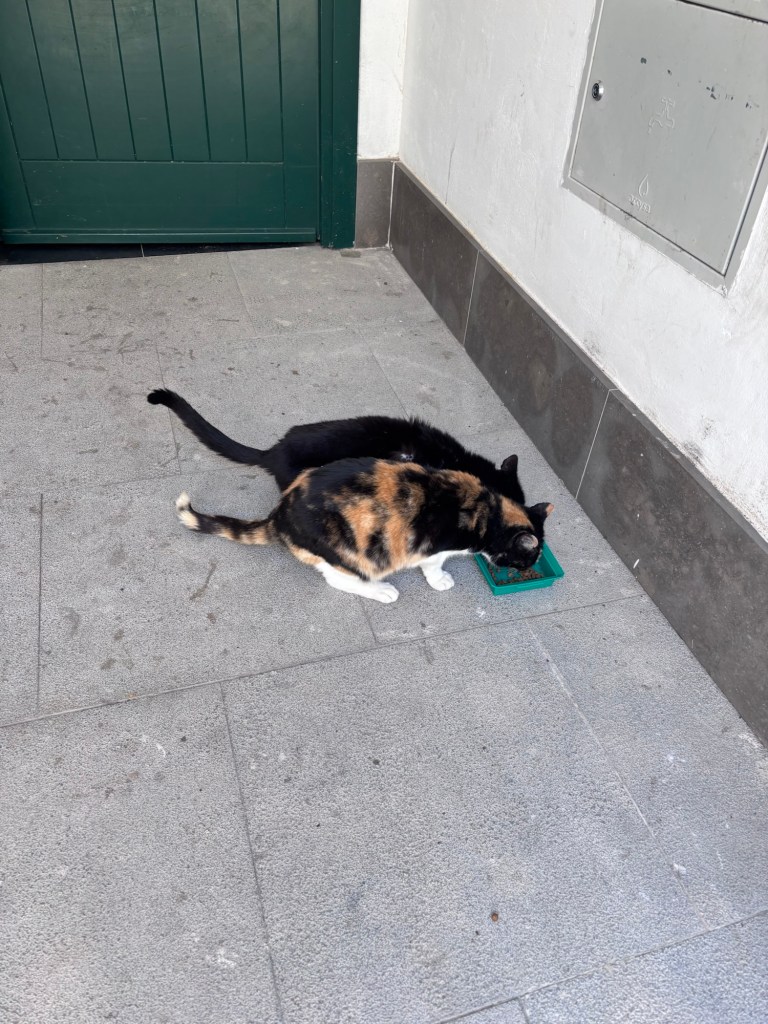
We were back at the albergue and ready for business by 2:00 when the doors are opened. First order of business: feed the hungry cats who are always waiting for us at the door, whether we are coming or going. There are about 5 regular cats of varying ages, size, colours, and well-being. They are the wards of this village, and part of our job while here is to keep the felines well fed – and this we do. One old gal has no teeth and is very skinny, so I hand feed her with softened kibble. She tugs at my heart strings. One of the calicos is pregnant. Another wears the scars on her face of a lost fight. Sadly, there seems to be no neutering of these cats and there are more on the way.
Two of our wards at the buffet
Tonight we have 5 pilgrims staying with us: 2 women from France and 3 men from France. One of the men twisted his ankle earlier today and had to take a taxi to get to us. While we are not allowed to accept pilgrims who arrive by car (or other motorized vehicles) we make exceptions for folks who have been injured and need a place to rest. And this man, legitimately, was injured. Earlier today I had to turn away 3 other men, who rolled up in their car, wearing golf attire, carrying no packs, and looking for a place to stay.
Wild flowers to make a tired pilgrim smile
We ended the day with a lovely bowl of soup (thank you, Dana!), some steamed broccoli, a glass of Rioja and a square of chocolate to seal the meal. It’s now just after 10 p.m. and I’ve locked the door for the night. Now to sleep.
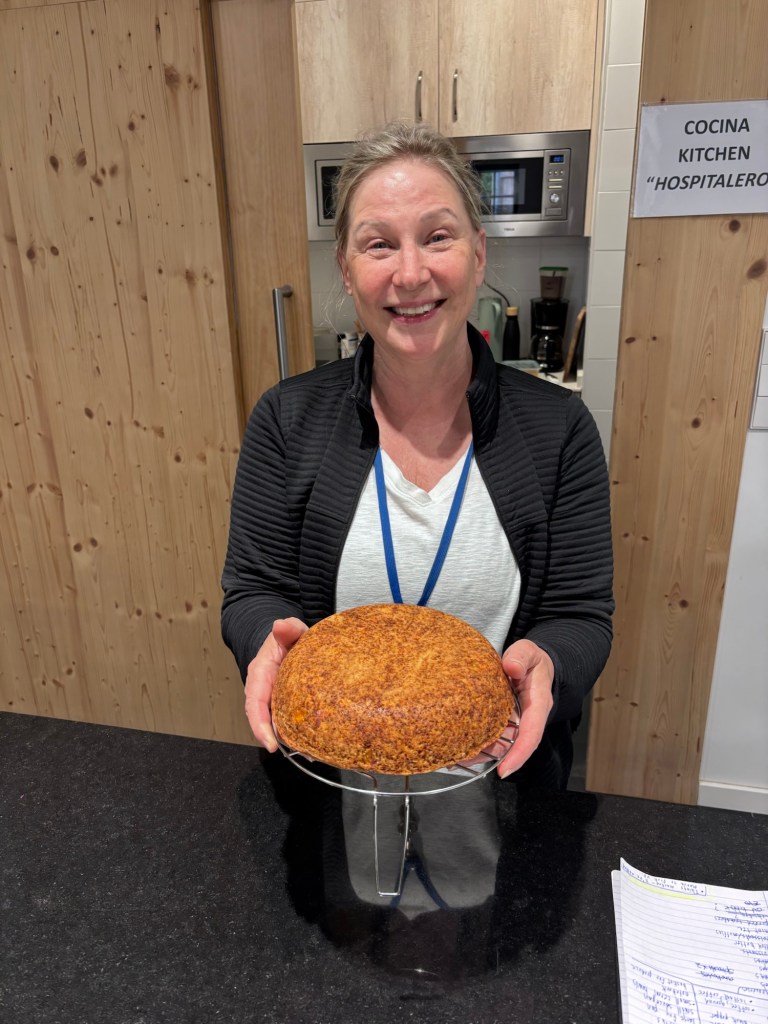
Last night we hosted five lovely humans – three men from Spain and two women from France. We looked after them by feeding them, offering clean and warm beds, and laundering their clothes. This albergue is a very nice one – it’s relatively new (built in 2021), with private showers and plenty of hot water, and a stocked kitchen for shared use. I also suspect that breakfast this morning was a real highlight for our “peregrinos” (pilgrims). Dana had made banana bread last night, improvising with a frying pan because we had no loaf pans in which to bake the bread. Along with the banana bread, today’s buffet included hot oatmeal, fresh fruit, yogurt, hard-boiled eggs, toast, and an array of beverages – juice, coffee, tea, and the fixings for hot cocoa. This was an especially abundant breakfast spread for a Camino albergue, where the usual offerings are long-shelf-life croissants and muffins (yuk), bread for toasting, jam, coffee or tea, and warm milk – for cafe con leche. Our guests were very appreciative of their night’s stay with us, thanking us profusely for our hospitality. When they left, I had that sweet feeling of having gifted something that landed in their hearts.
Dana’s banana bread
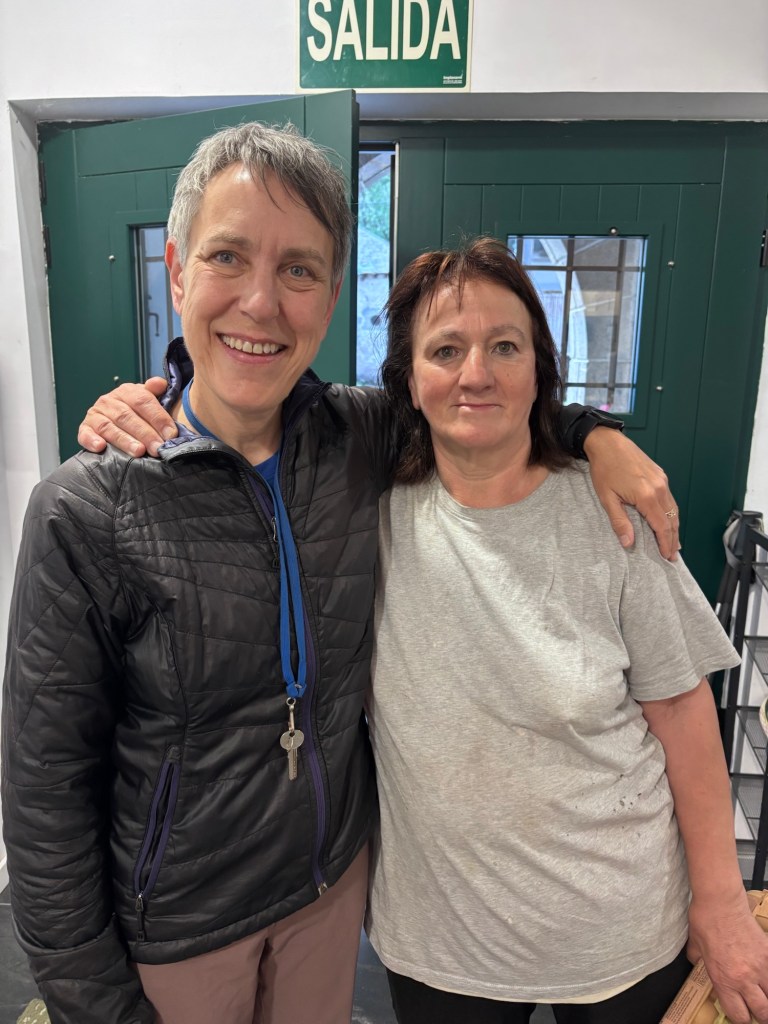
But then…there was a knock on the door. I opened it to be greeted by a man who asked (in Spanish) “Do you remember me”? I did not. Nonetheless, I invited this man into the albergue, seeing he wanted to talk. The man proceeded to tell me that he was one of the people who asked to stay last night, and I had turned away. Last night, this man and two other men had shown up in a car – and this is not allowed at our albergue and at many others, especially “donativo” albergues, which cater to pilgrims who are walking a Camino. It was now 8:30 a.m. so this guy was delaying the start of his walk or his ride to come and speak with me. He began to scold me for turning him away last night. I tried again to explain our policy to him, but he would not accept this rationale and became rather rude. Dana joined me at the door and together we tried to explain, but this man was not interested in listening. He berated us for not being real hospitaleras, finger wagging at us saying (in Spanish) “you need to learn about Spain and you need to learn Spanish.” I was and have been doing my best to speak Spanish with our guests and visitors, so this felt particularly harsh. Knowing the conversation would go nowhere, we ushered this obnoxious man out, saying “adios y buen Camino,” and closed the door.
This is part of the deal with being a hospitalera: we will host lovely, warm and appreciative pilgrims, and we will encounter other people who will go out of their way to be mean spirited. You take the good with the bad and trust that goodness will prevail.
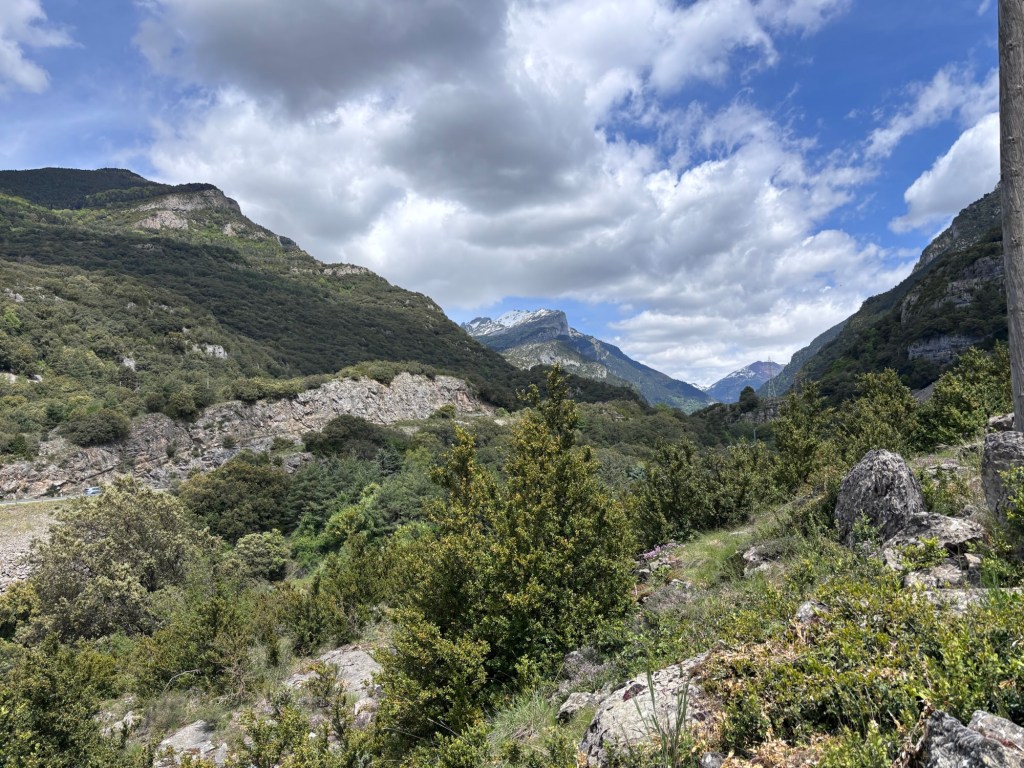
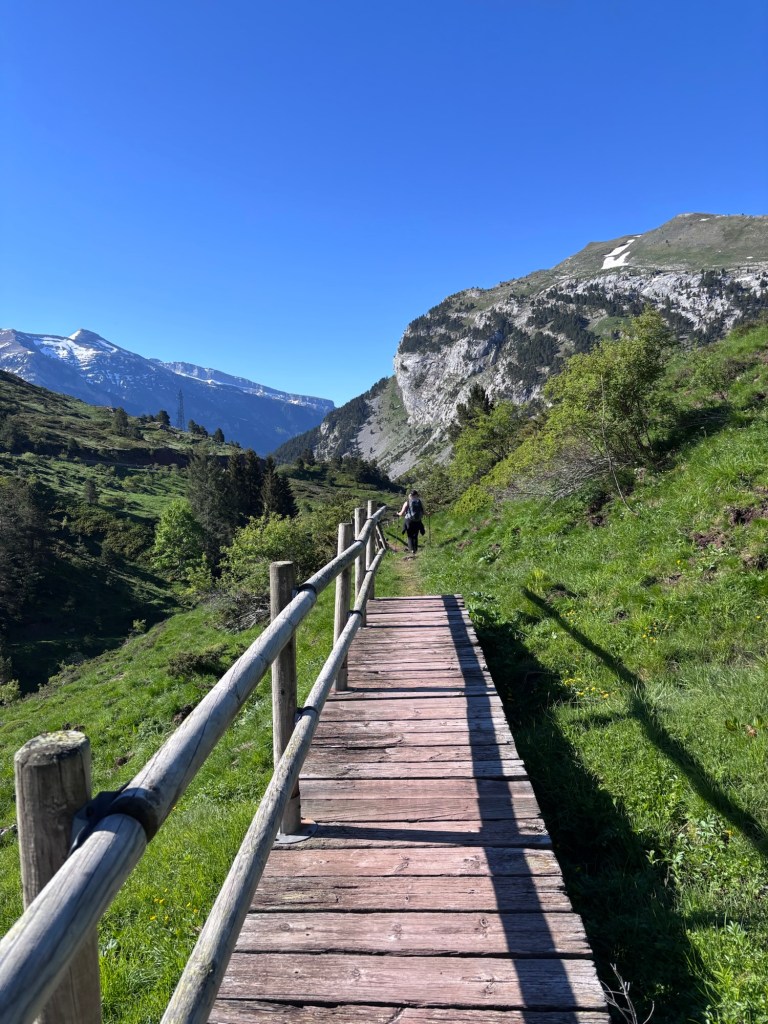
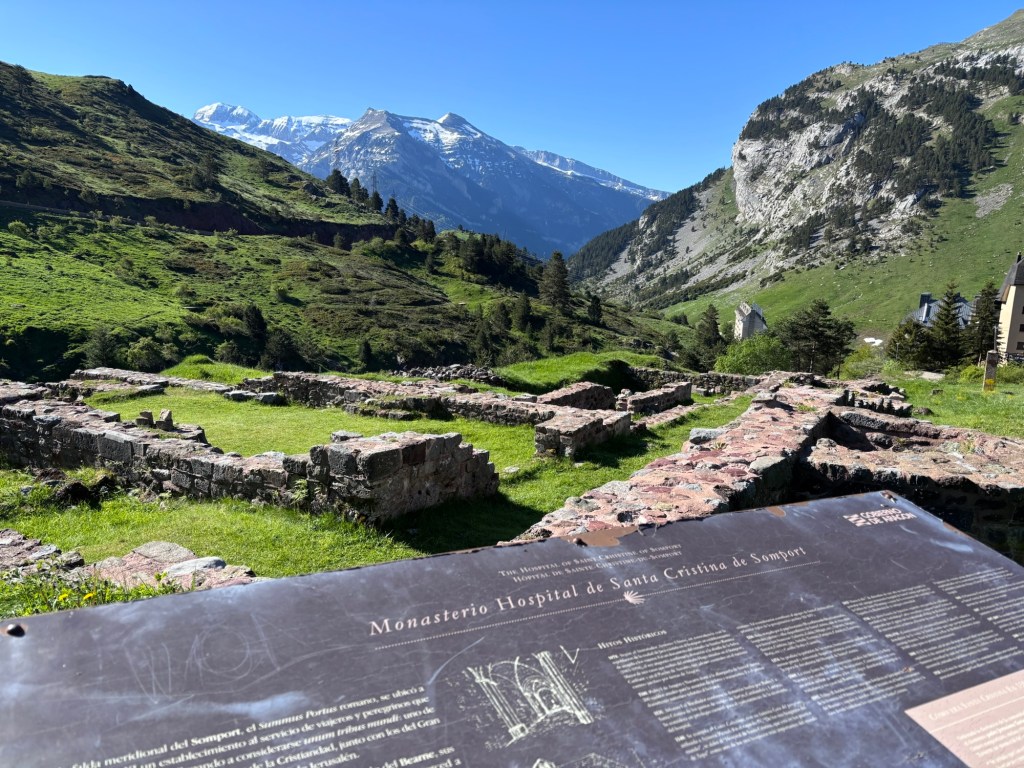
Yesterday we took a bus to Somport, a border crossing in the Pyrenees between France and Spain, sitting at 1,632 metres above sea level. The bus ride from Canfranc was a quick 20 minutes, and from there we meandered our way at a leisurely pace down the mountain – 12 kms – back to our little albergue in Canfranc. The views were stunning with the snow laced mountains all around on a sunny mid-May day. The trail down the mountain was well marked and the switchbacks made it easy to traverse.
The trail from Somport
As you might imagine, this area around Somport is ski country, but at this time of the year when ski season is over and the summer tourists have not yet arrived, the villages around here are shuttered. This meant that we had the trails to almost to ourselves. And with the weather turning from cold to warm in just a day, I was very pleased to finally put on the pair of shorts I brought along.
Ruins of an 11th century hospital for travellers
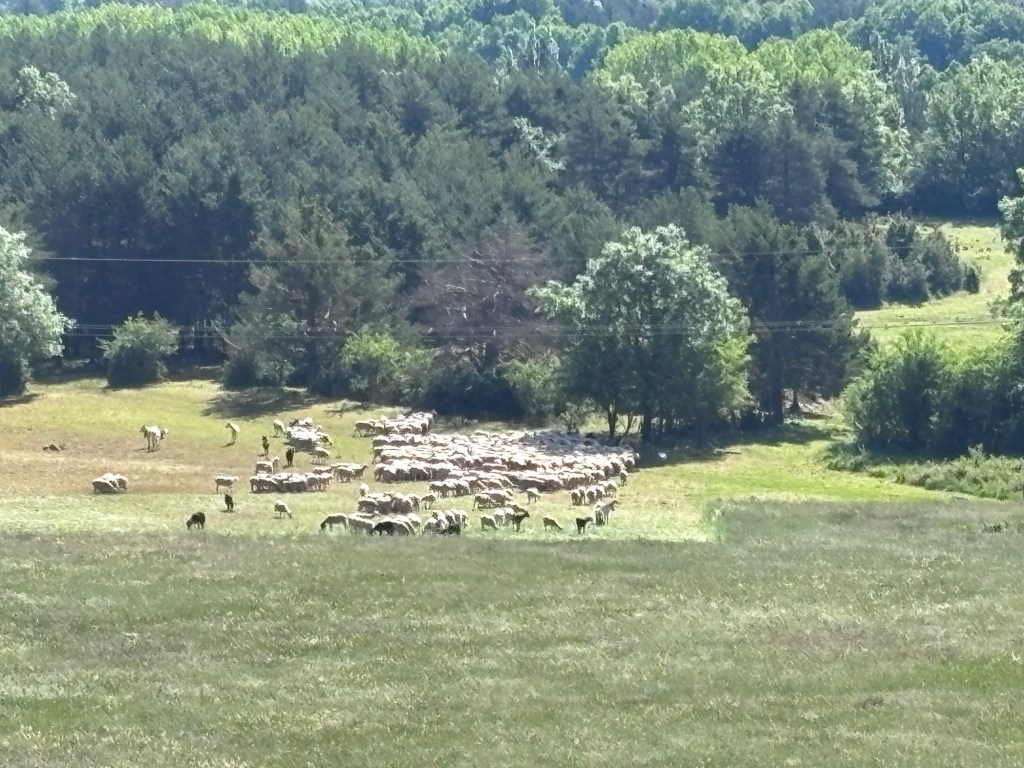
Today, I walked the other direction from Canfranc – towards Santiago (just 855 kms away) – to Jaca, a relatively sizeable city in the region. This was a rather easy 20 km walk, with mostly flat terrain and a fairly empty pack. The views today were bucolic. Instead of snowy steep mountains, I walked by farmers in their fields, herds of cows wearing bells, and sheep being corralled by dogs. I really enjoyed watching these dogs at work with their sheep.
Flock of sheep
I had hoped to visit the cathedral in Jaca, but by the time I got there it was closed for the long 2 and half hour siesta. I had also hoped to purchase a bus ticket to Zaragoza for my trek to Madrid on May 31st, but for some reason the tickets for that day – just 9 days away – are not available yet. Transit here can sometimes be odd to navigate. Oh well, I will try to sort this out another day.
Back at the albergue…tonight we are hosting three men from France who were very relieved to find a bed for the night after a long 30+ km day. We shared some food and drink together, and swapped tales from our various Caminos.
It’s hard to believe that I’ve been volunteering at the albergue in Canfranc for a week already. One more week to go, and by then I should have a really good system in place. This coming week will be different, however, because my fellow hospitalera, Dana, left Canfranc today for Pamplona, and I’ll be flying solo this week. Dana and I had planned to walk the Aragones together before serving in Canfranc, but she got sick and had to skip the trek. So, I encouraged Dana to get her Camino in this week, and I am glad she took me up on this offer. It would be a shame to travel all the way to Spain and not experience The Way.
Last night’s guests were a sweet trio of men from France, all experienced pilgrims. Rested and fed, they walked off to Jaca today.
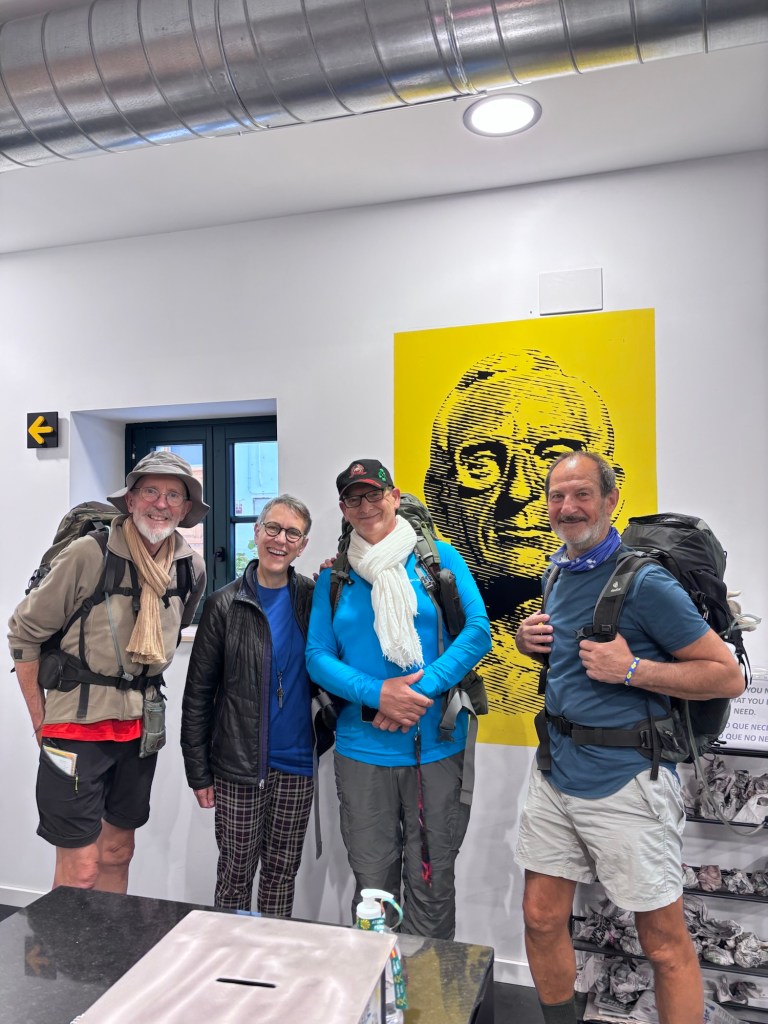
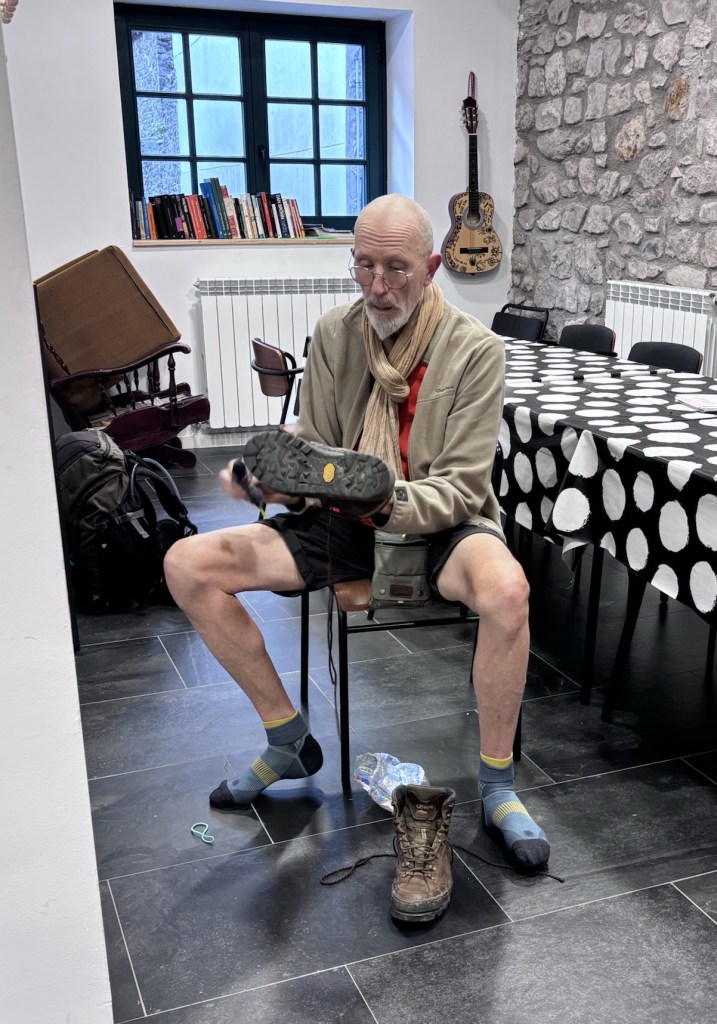
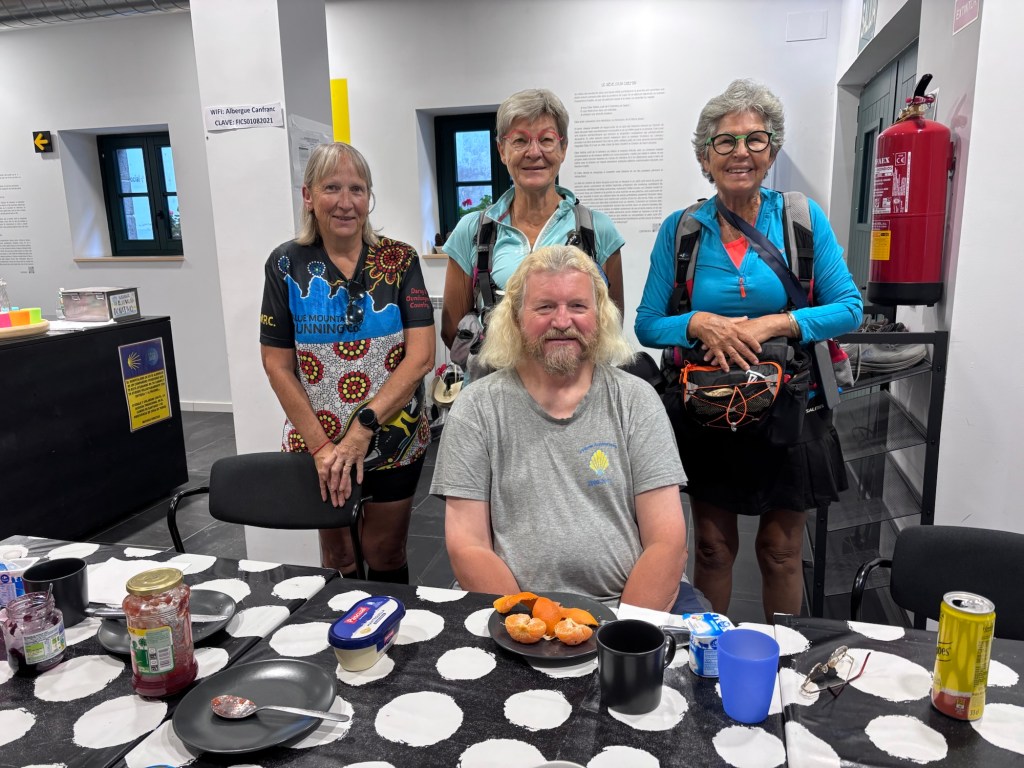
Xavier, me, Jean-Louis, and ChristianXavier polishing his boots for the day.
Tonight we have 5 pilgrims at our albergue: two women from France, one woman from Mexico, one woman from Australia, and one man from Austria. It’s a really nice mix of folks who seem to be enjoying this space together.
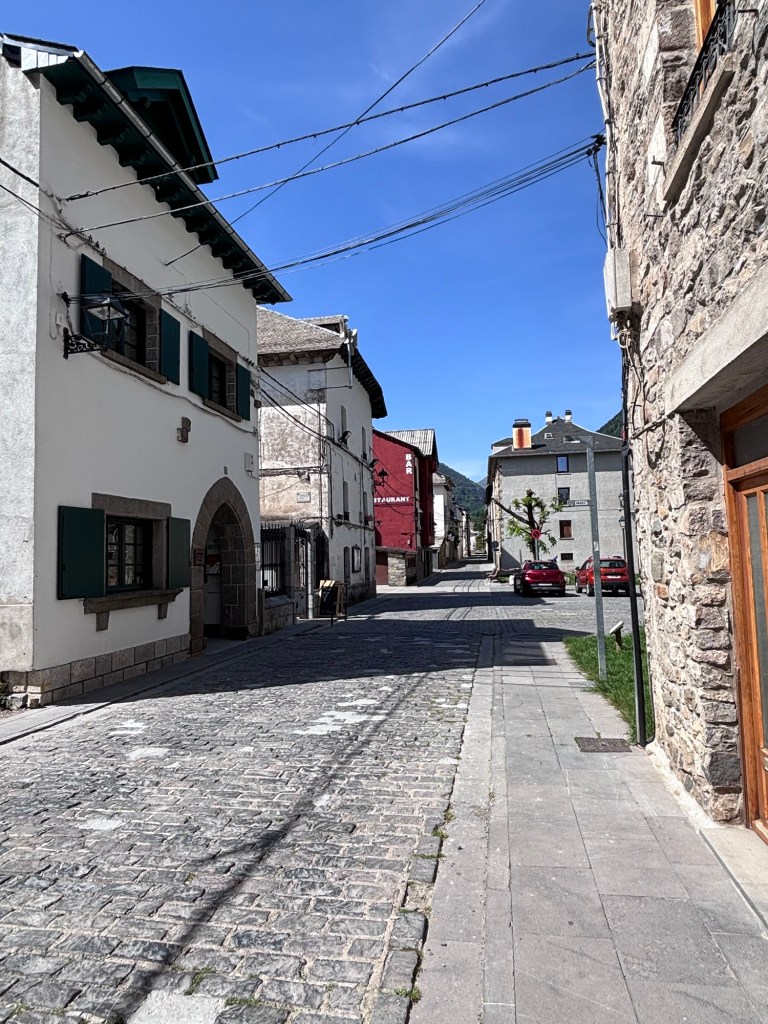
Canfranc Pueblo, where I am spending two weeks, is a very small village. The official number of inhabitants as of 2025 is 633. I thought my home town was small, with 1300 people, but Canfranc is really small. It has one main street, which runs parallel to the Aragon river, its natural boundary to the east. Canfranc’s one bar has been closed (for renovations) for two weeks now and will reopen in a few more days. So the locals gathered for their Saturday night in the wee park next to the church, which happens to be across the street from the albergue. The group was having a good time, but they were loud, and worse yet, their dogs were barking non-stop for over an hour. I love dogs, as many of you who know me would know. But a trio of barking dogs, no matter how endearing, are still annoying. So, at about 10 p.m. I walked over to the park and asked them to quiet their dogs. They ignored me. I could see the source of the incessant barking – a Jack Russel Terrier with a ball. Of course. I retreated in defeat and frustration.
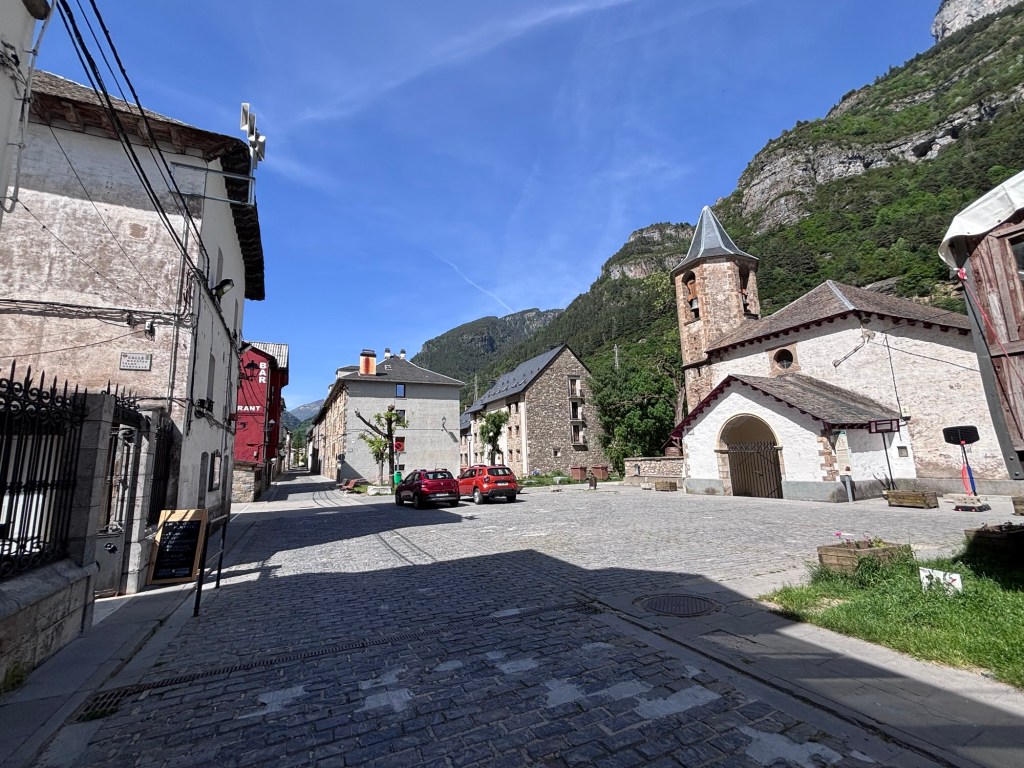
Canfranc Pueblo – “town square”Canfranc Pueblo’s one street
I was tired. An hour earlier, one of our pilgrims became sick and had an accident in the dormitory corridor. So, on with the gloves and out with the bleach, and I was cleaning and mopping the floors, and laundering soiled clothes. How terribly embarrassing and upsetting this was for the Pilgrim, and this their first day on the Camino. I gave the Pilgrim my supply of immodium and hope this gets her through the 20 km walk she planned for today. We can plan our Caminos, but life unfolds as it will, and we work through it. We walk on.
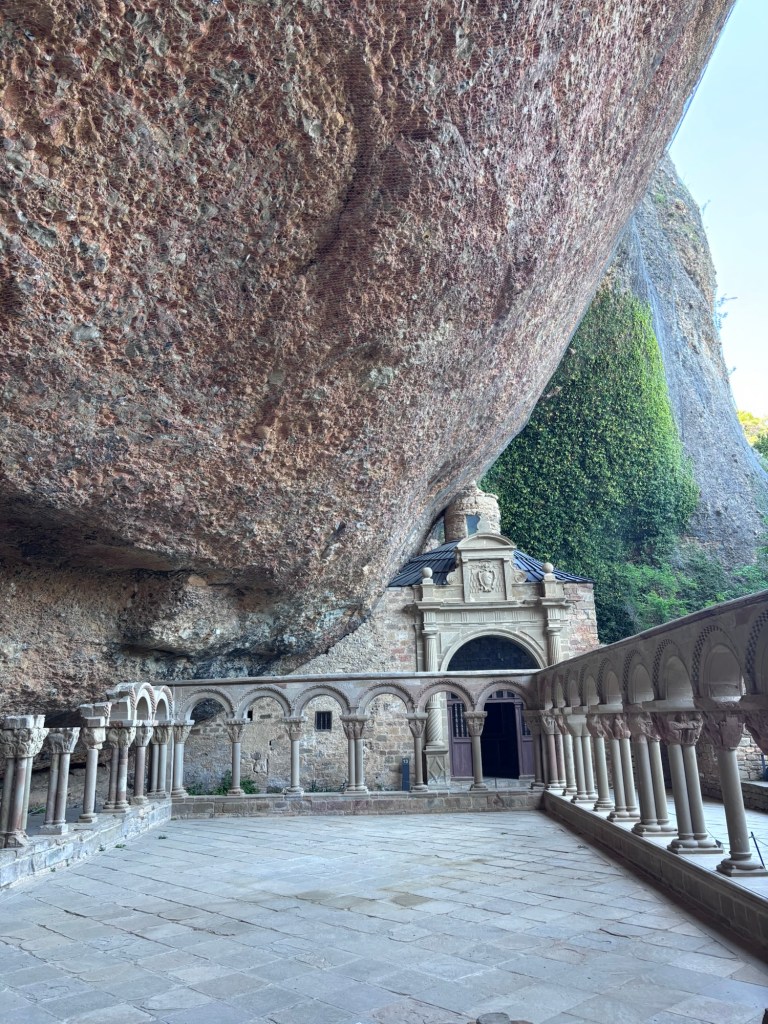
How did they do this? San Juan de la Peña – a monastery built into the steep cliffs of the mountains to honour St John the Baptist – is an architectural wonder. The monasteries (there are two of them) are located in northeast Spain, a 35 minute drive on windy roads from Jaca or a 6 1/2 hour walk. I got there yesterday by taking the “workers bus” at 9:15 a.m. from the Jaca bus station, a tip I learned from other Pilgrims. Returning to Jaca requires patience, planning or good luck. You can wait for the “workers bus” to return to Jaca at 7 PM or you can arrange for a taxi to fetch you from Jaca at the cost of €40, or if you’re lucky, like I was, one might catch a ride with someone. Through the Tourist Office the day before, I had arranged for a taxi to pick me up in the early afternoon at the monastery. But in my rush to leave the albergue in the morning, I left the taxi driver’s number behind. Thankfully, my good fortune connected me with a a friendly Kiwi couple, whom I met at the monastery; they happened to be staying in Jaca and offered me a lift back to Jaca in their rented car. The Camino provides.
The two monasteries at San Juan de la Peña – include the “Old” one first constructed into the cliffs in the 10th century and the “New” one built in 1705. From the 10th century onwards various improvements were made to the Old monastery; the cloister was built by the Benedictine monks in 1109. Later in the Middle Ages, the Aragon royalty, thinking the old monastery was pretty cool, decided this would be an ideal place to bury their kings. And so they did. The New monastery was built – about 1.5 kilometers up the hill from the old monastery – after a fire destroyed sections of the Old Monastery.
I was happy to have seen these monasteries, especially the Old one. The New monastery offers a lot of history about the Church and the monarchs who ruled Spain over the years, and a bit about the Camino Aragones. But one needs to be able to read Spanish because there are no translations into other languages. My Spanish is not that good so a lot of this information was lost on me. 
The Old Monastery
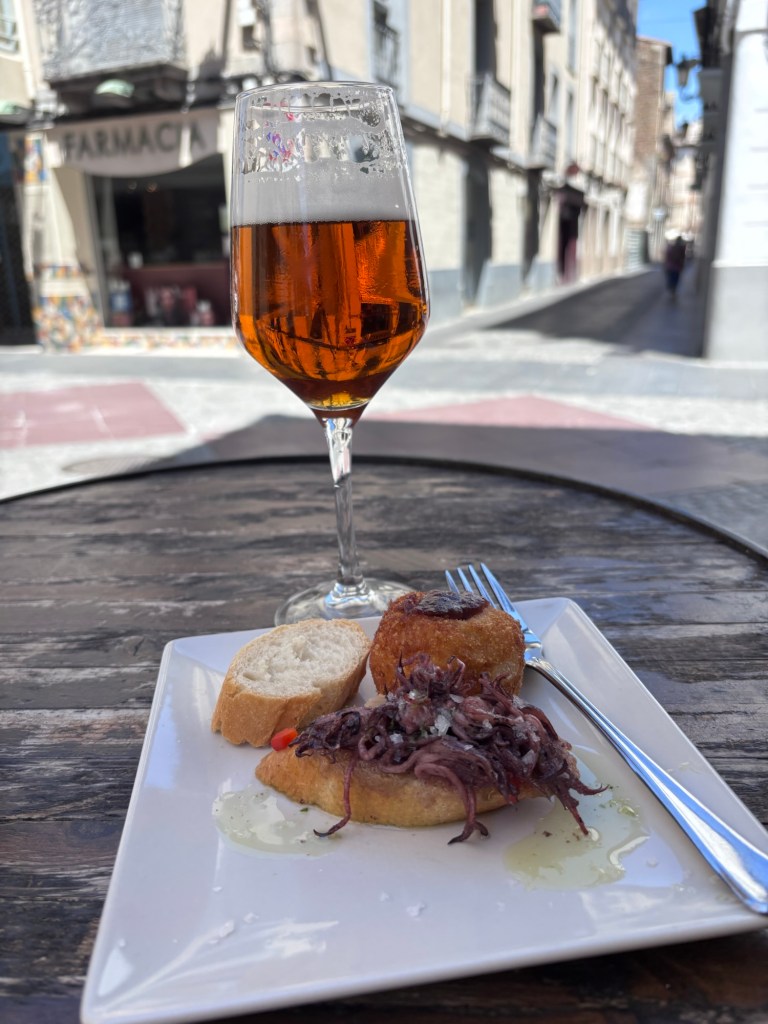
I had an hour to spend before catching the public bus from Jaca back to Canfranc Pueblo. It was lunch time so I found a little bar on Calle Mayor and enjoyed a beer and a couple tapas: marinated squid and a “cheese ball”.
A construction crew was hard at work on the building next-door this morning. Buzz saws, metal-against-metal pounding, and lots of chatter in between. What a perfect day to escape little Canfranc Pueblo and go to Jaca, the big city 25 minutes by bus away. I ran to the bus, which is often early, but today it was right on time, as was I, and off to Jaca I went. I was working on little sleep (just 6 hours) after another late night and early morning. I had no agenda except to stir up a change of scenery and wander the streets of Jaca’s old town and experience whatever presented itself.
Jaca is a major stopover for Pilgrims on the Camino Aragones, and has been since the middle of the 11th century. Sancho Ramirez, one of the Christian kings who ruled Aragon from 1063-1094, made Jaca his capital. By then, pilgrims had already begun making their way to Santiago, in northwest Spain, to pay homage to the bones of St. James. The story of how those bones got there from Jerusalem, where James was beheaded by King Herod, is a real head-scratcher to the cynics among us. (More on that later). King Sancho, wanting to encourage pilgrims to travel through Jaca, sponsored the construction of bridges for easier travel and hospitals to take care of weary pilgrims, and thus the Camino Aragones became one of the Ways of Saint James.
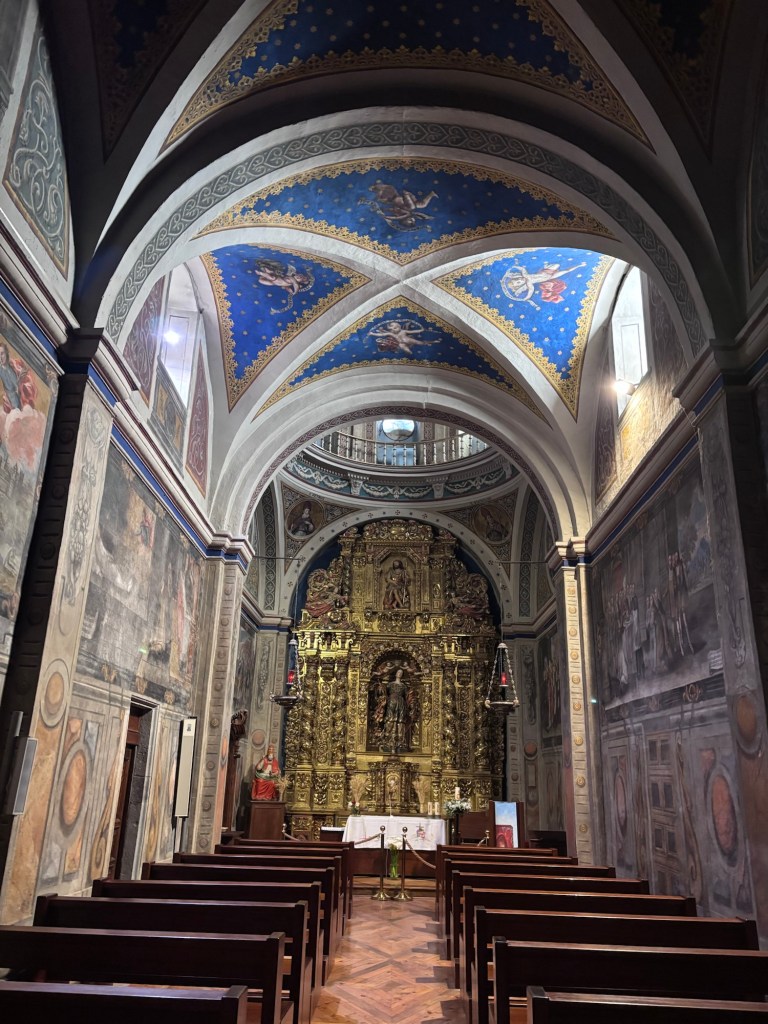
Jaca has two major sites on the current traveller’s agenda: the Cathedral of St. Peter, built between 1077 and 1103 and the Citadel, on which construction began in 1592 and continued for the next 200 years or so, as these things go. The Cathedral is small by comparison to the cathedrals I’ve seen in other cities, but it seems proportionate to the size of Jaca as a small city. Inside the Cathedral I lingered in the Chapel of Saint Orosia, with its baroque alter, delicate frescoed walls and vibrant painted ceiling. Orosia is the patron saint of Jaca, a Bohemian princess, whose family had arranged for her to marry a Moor. Being the devout Catholic that she was, Orosia, ran away, hid in the woods, was discovered and then beheaded for her defiance.
Chapel of Saint Orosia
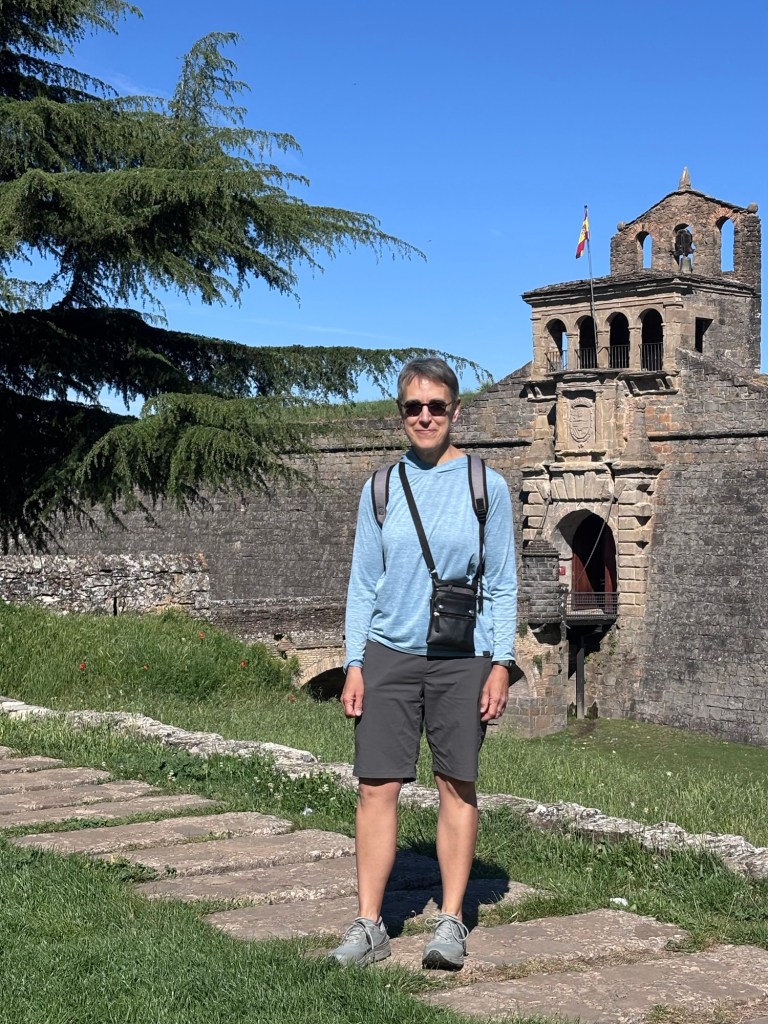
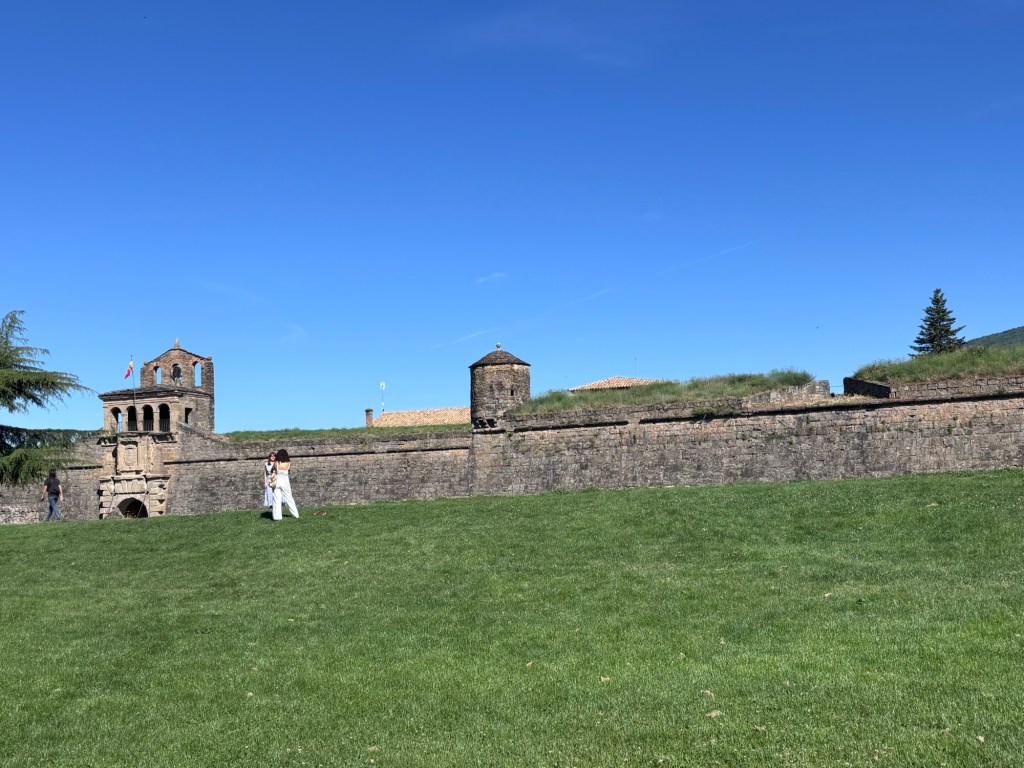
I did not bother going inside the Citadel which has a military history collection and a collection of miniature tin soldiers. Not my thing. Walking around the perimeter of the Citadel was all I needed to do.
Outside the Jaca Citadel
I spent the rest of the early afternoon strolling the streets of old town, window shopping and doing some actual shopping – to buy groceries for the guests at the albergue. Before catching the bus back to Canfranc Pueblo, I enjoyed a beer and a snack at a bar. Sadly, I’ve yet to find a gelato shop that is open in Jaca. This confuses me.
I left Canfranc today. I served up my last breakfast to our four overnight guests, threw my last load of bed linens into the washing machine, and handed over the keys to Jacqui, my replacement hospitalera. I said my goodbyes to the two Maria-Joses, my local contacts, and offered my last behind-the-ear scratch to Cima (pronounced “Theema”), Canfranc’s cutest pooch. Pickle is packed to the gills, having added a couple cold weather items to my stash – which seems absurd now that the temperature has climbed to 30 C. On the first day, I arrived at Canfranc it was -1C with a few snow flurries.
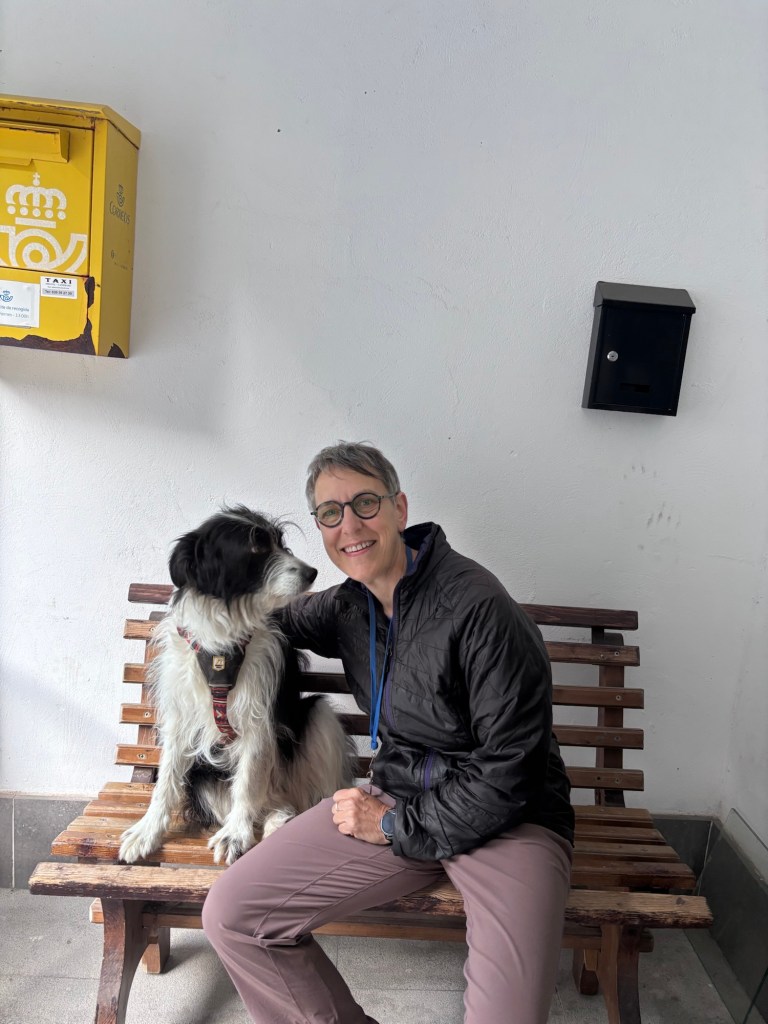
Jacqui Marie-JoseCima and me
I feel ready to move on. The late nights and early mornings left me a bit spent. But I feel good about the care and kindness I extended to the pilgrims I hosted. One very experienced pilgrim, who walked more than 15 Camino‘s over his 78 years, said to me “I think you’re the best hoapiralera I’ve ever had.” That refilled my tank. Over the course of the next few days I will sift through these experiences and try to make a bit more sense of it.
As I sit in the Zaragosa train station, having gotten here by bus, I await my train to Madrid, the last leg of this Spanish adventure before I move on to Italy. I can’t wait to get some gelato and espresso, two delicacies that I’ve failed to find to my satisfaction here in Spain.
I left Madrid in the late afternoon of June 1 and flew to Bologna on a bare-bones Iberia plane – no screens, no USB ports – and little attention to comfort. Thankfully this was a short two hour flight. I took the Marconi Express light rail train directly from the airport to Bologna Centrale train station where Sheila me. After dropping Pickle off at the hotel, we walked to a sweet little trattoria and enjoyed a delicious meal of gnocchi with butter and sage sauce, grilled vegetables and a glass of chilled Lambrusco. This was not the Riunite Lambrusco of my late adolescence.
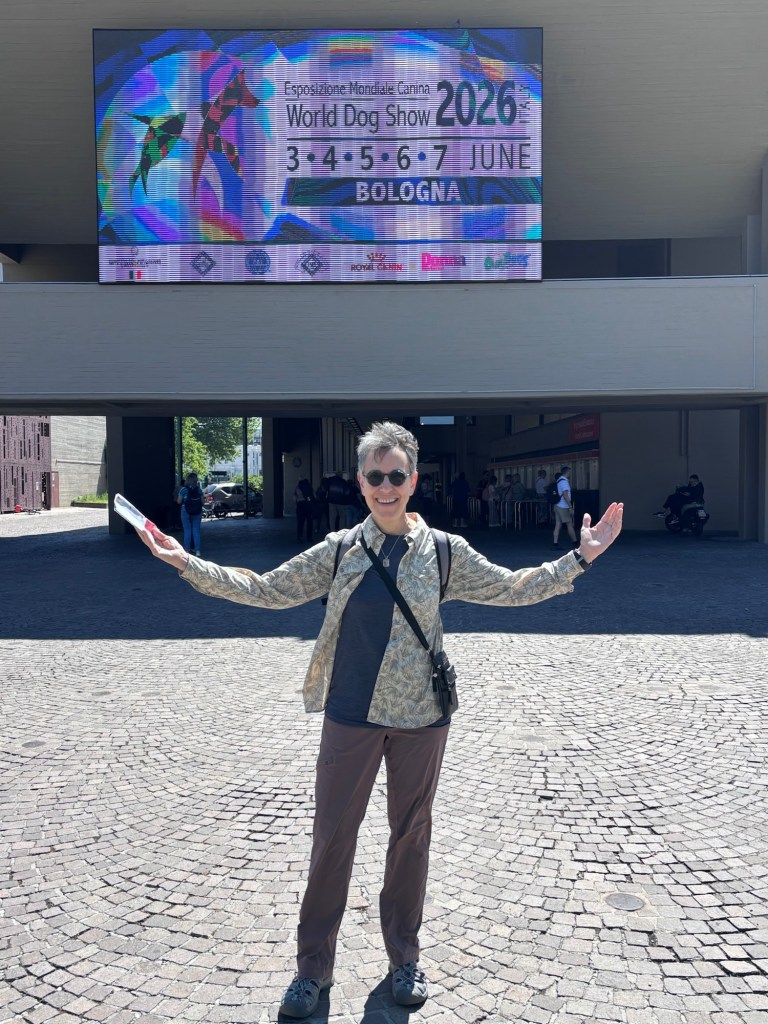
When we were trying to book accommodations for Bologna a few months ago, hotel rooms were hard to find. So, I asked the oracle: “what’s happening in Bologna, June 3rd?” The World Dog Show! Yes!! This thrilled me and we decided that this was a must-do when in Bologna. We later found out that Metallica was performing on June 3rd. Although attending a Metallica concert would be a form of torture for me, we saw lots of fans milling around the street wearing Metallica T-shirts and Metallica (or some closely related head-banging music) being played at some bars, so it seems the World Dog Show was not the only show in town.
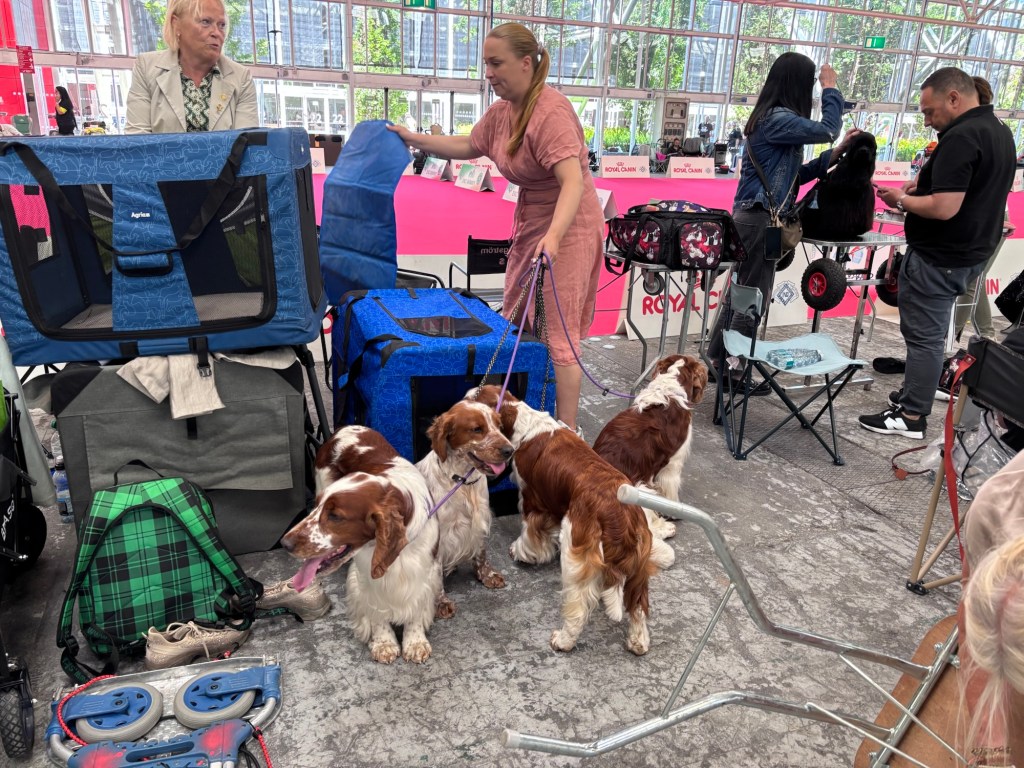
The World Dog Show was a hoot. A short bus ride to the conference centre got us there and a 10 Euro entrance fee got us into the show. Information about the Show was sparse, so we had no idea what to expect. Even the day before the show, the official website stated “information coming soon.” The people showing dogs, their groomers, or vendors of dog care products, tools, food, clothes, etc., were in the know, but having no expectations meant that we were surprised by what we got to see.
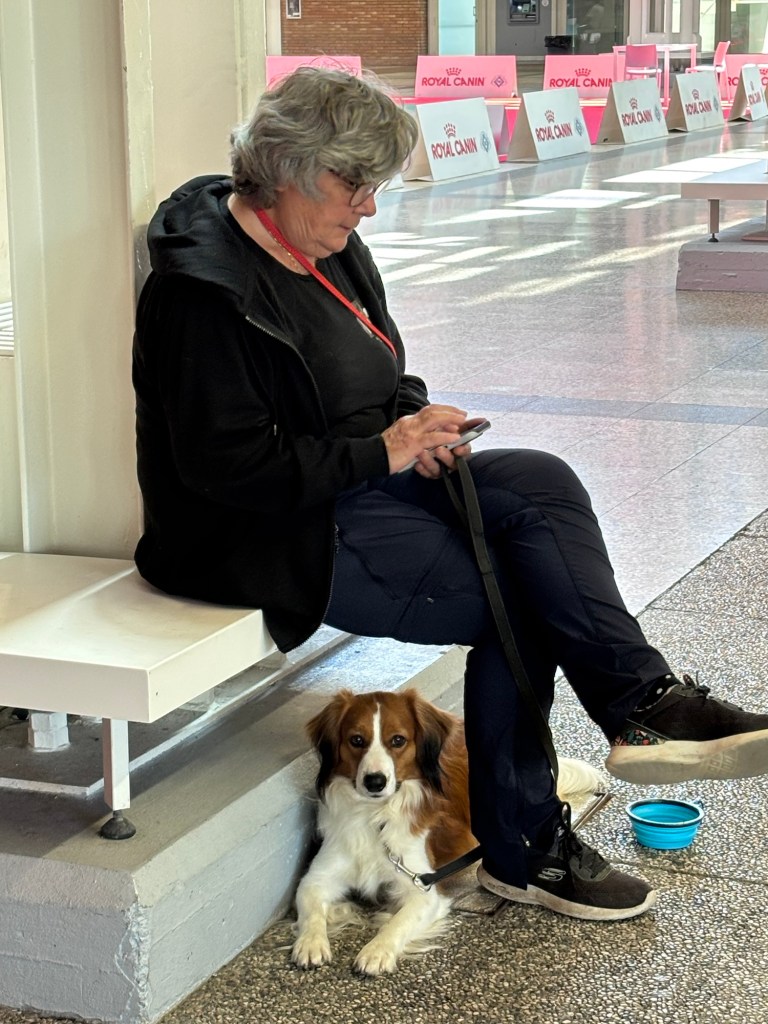
Brittany SpanielsKooikerhondje
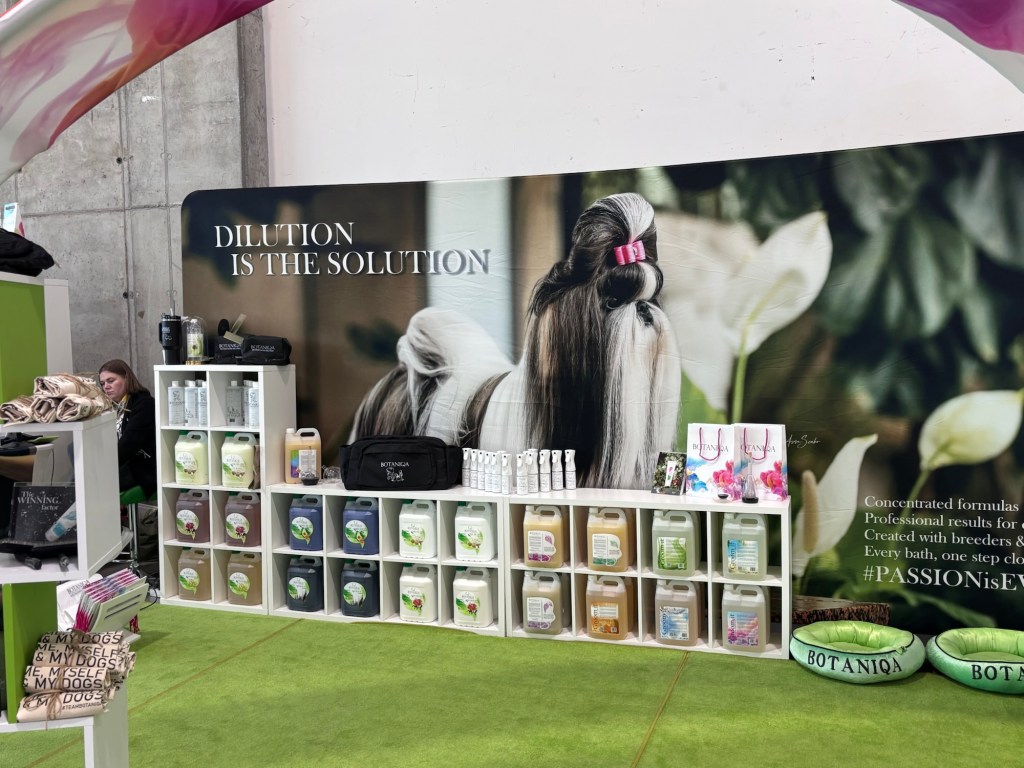
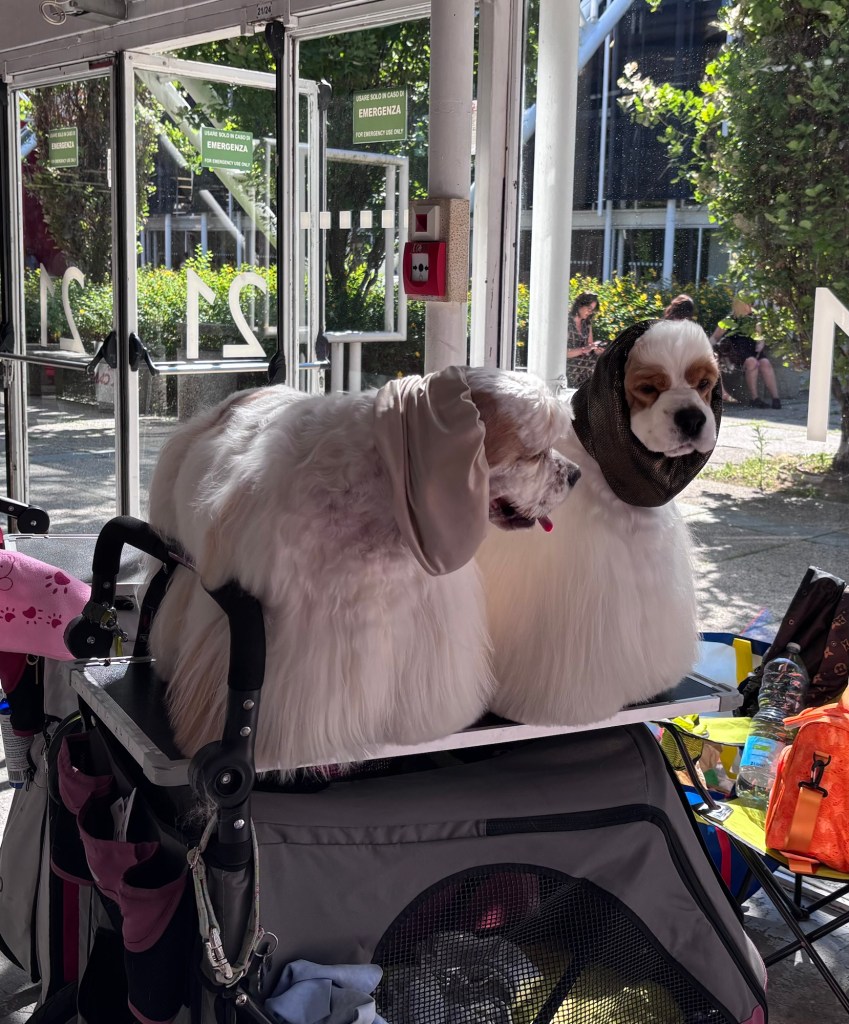
The array of dog related paraphernalia was impressive: Grooming tools, special shampoos, oils, ear muffs (to hold back floppy ears), collars, leashes, bathtubs, and more. Anything you can imagine to pamper your pooch could likely have been found there.
Canine cosmetics
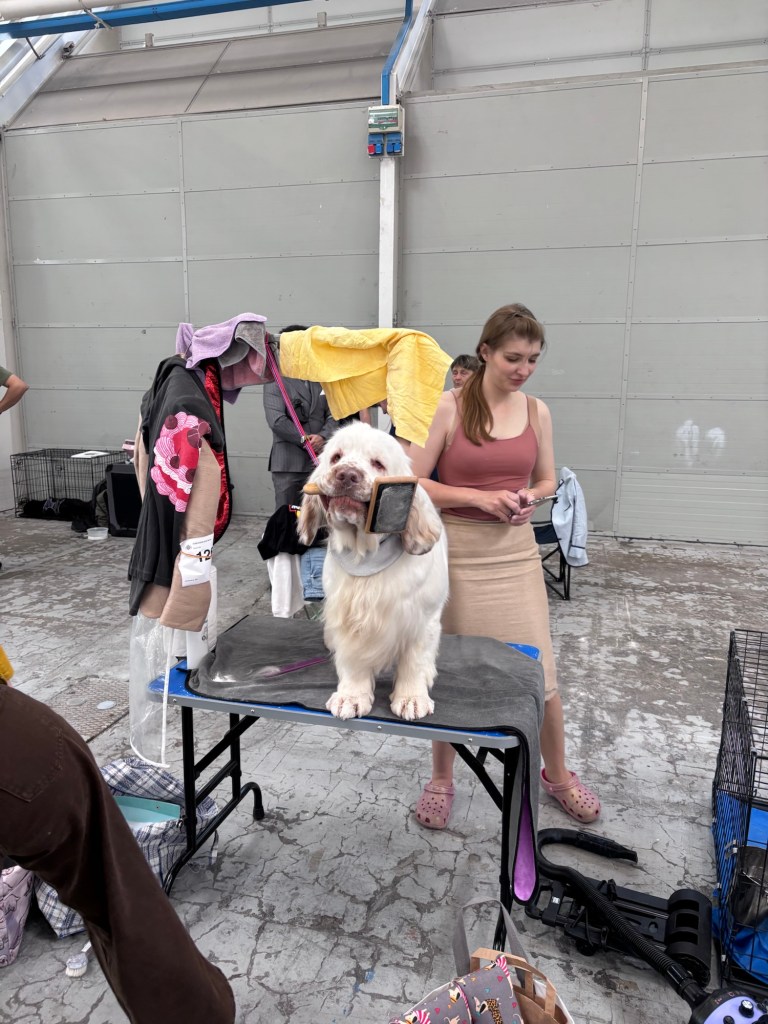
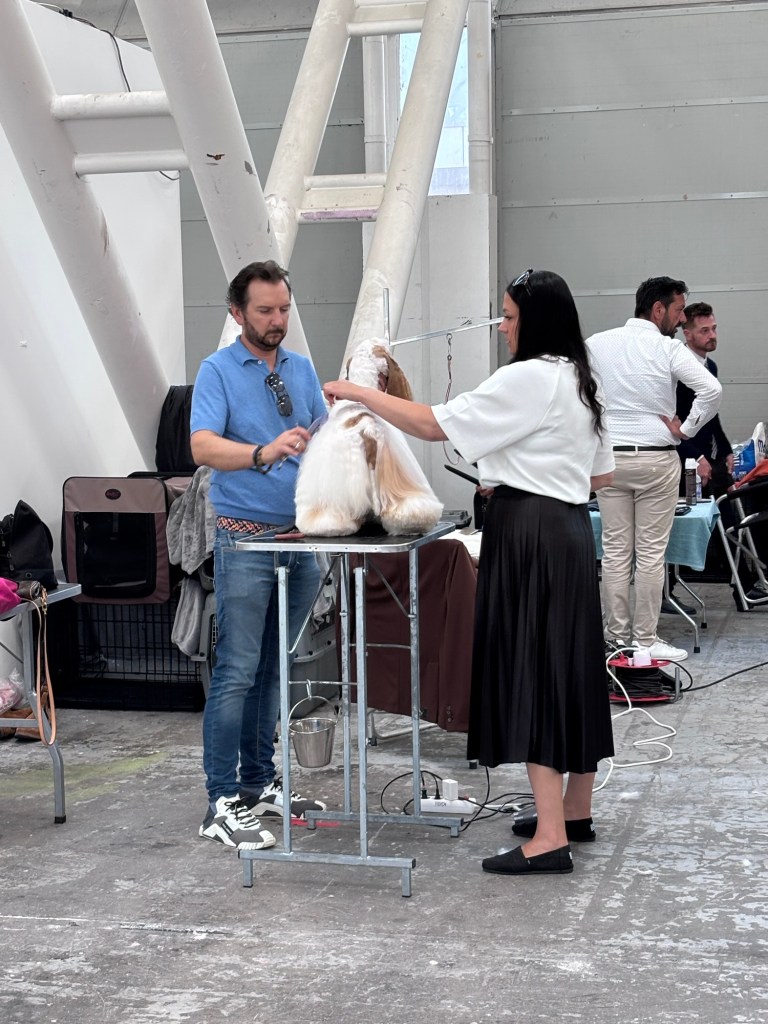
Grooming is serious business …
Ear muffs
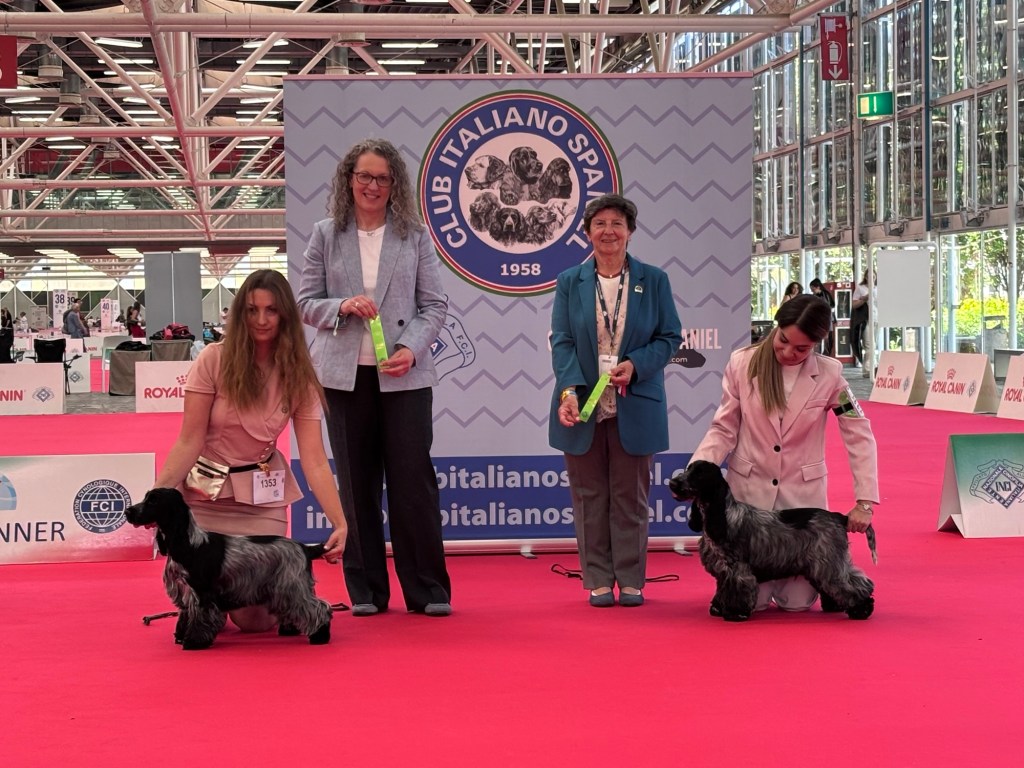
We saw lots of dogs, but focused most of our time in the hall with the Spaniels – Welsh Springer Spaniels, Brittany Spaniels, English Springer Spaniels, English Cockers, American Cockers, Clumber Spaniels, and the Kooikerhondje, a Dutch Spaniel. Unfortunately, the King Charles Cavaliers – for which I have a special affection – were not competing the day we went to the show. Within each breed, competition was further separated by colour, sex, and age. So, for example, the “junior” black and white female English cockers had a round all to themselves.
More Spaniels
Bologna was a great city to wake up my senses to Italy – great espresso on every street (and I am not exaggerating), gelato, delicate filled pasta, art and architecture that make you go, “wow.” Next up – Cremona, the city of violins.
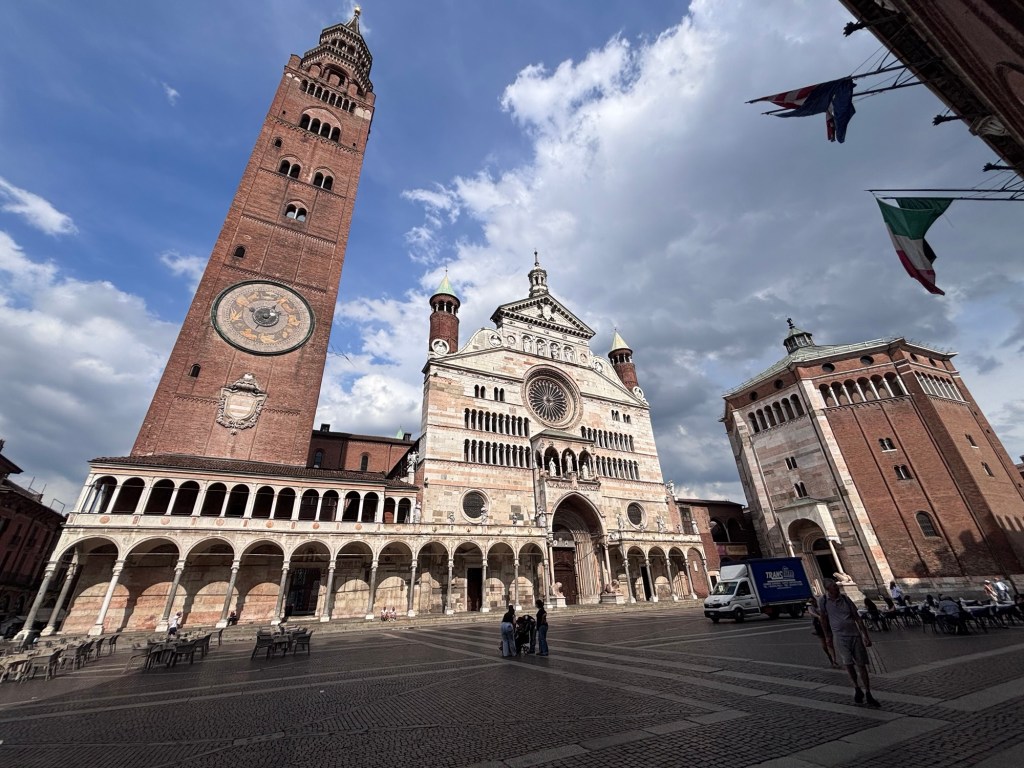
We traveled from Bologna to Cremona by train on June 4th and spent three nights in a garden apartment there – owned by Claudio and Rafaella, who live in the second floor apartment above. Cremona, another northern Italian city in the province of Lombardy, is about 100 kms east of Milan and 160 km west of Bologna. It’s a fairly small city of about 71,000 people and not on many tourists’ itinerary, which is one of the reasons we wanted to go there. Cremona is best known as the place where fine violins have been made since the 1500’s. The most famous of these violin makers, Antonio Stradivari, worked and lived in Cremona from 1644-1737.
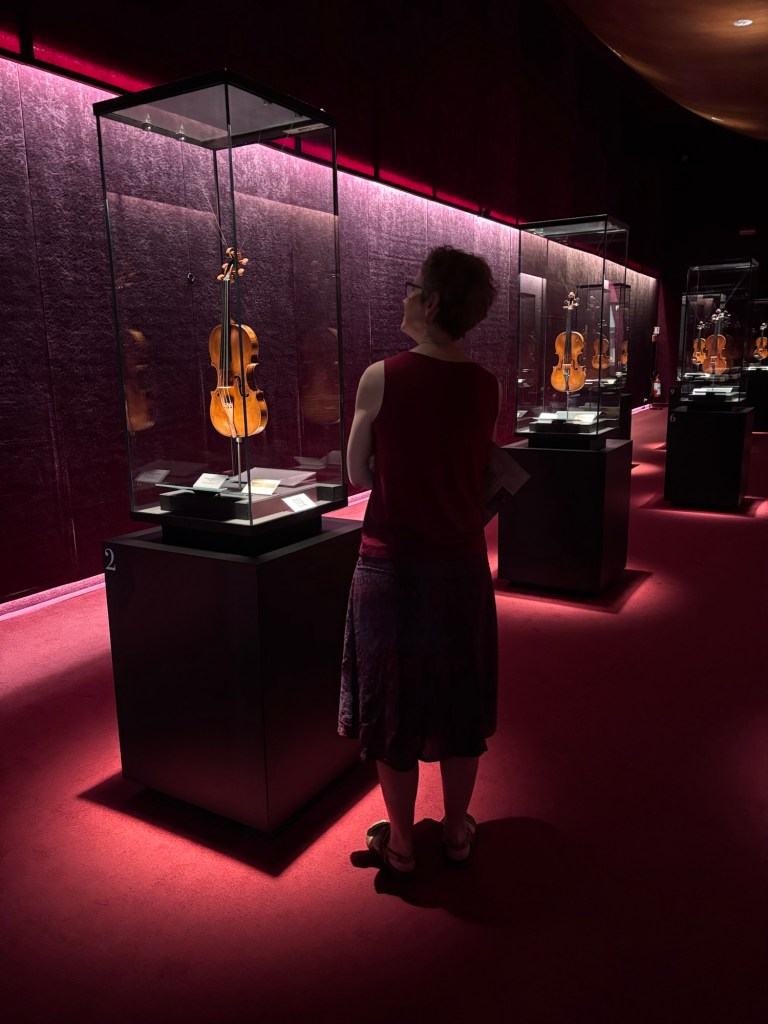
We visited the Violin Museum, which is a must-see in Cremona. There we learned about the history of violins and their making; saw a collection of violins from the 1500’s to the 1800’s; and listened to violins being played in an immersive surround-sound dome – simulating what one would hear if sitting in the middle of an orchestra. The fine and old violins in the museum are valued at millions of dollars, some on loan, some as gifts for keeping.
Sheila admiring a violin
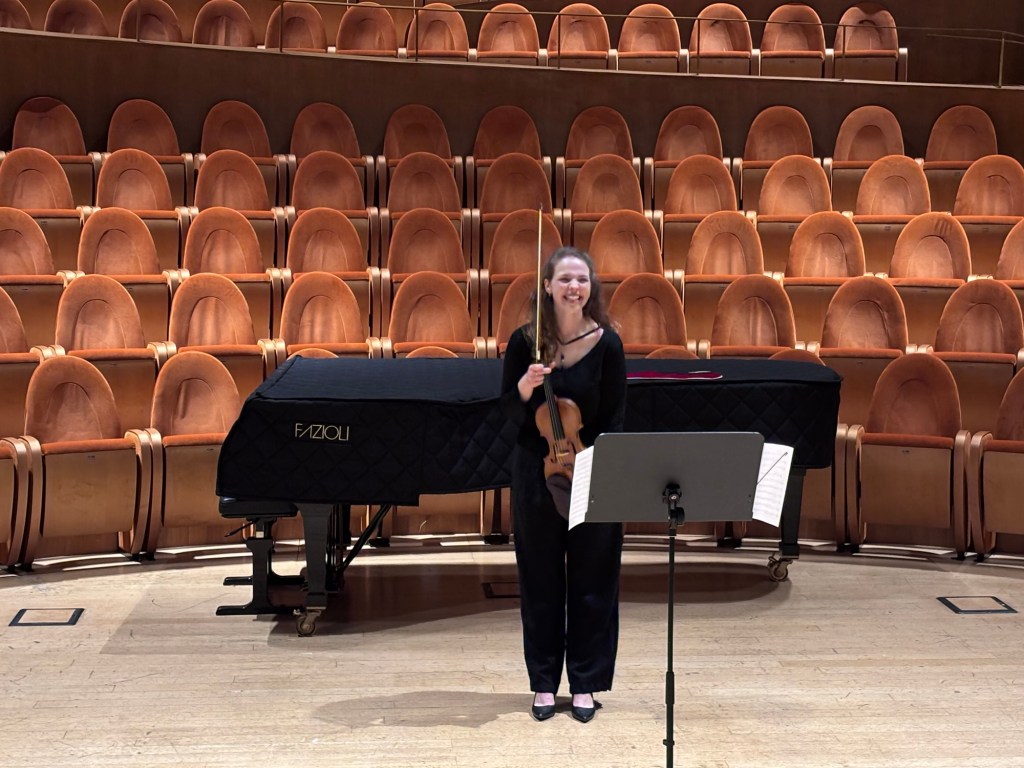
I am not a musician, but I do love music. And the violin – with its range of textures and sounds is quite special, in a class all by itself. One of the highlights of our time in Cremona was a concert – at the Violin Museum – where we got to hear a woman play a violin made by Giuseppe Guarneri in 1734. The violinist was so delighted to play this magical violin that we thought she just might bust at the seams. And what a joy for us to hear her play.
Lara Celeghin playing a 1734 Guarneri
Besides its treasures of violins, Cremona is a sweet city. It’s a living city, not a tourist stop. We did not see a single hotel there. In our three days in Cremona we watched the same sets of people – walking their dogs, drinking their morning espresso, sipping their pre-dinner wine (their “apertivo”), and enjoying each other’s company. And we saw lots of people of all ages toting musical instruments around – presumably lots of violins, and cellos too.
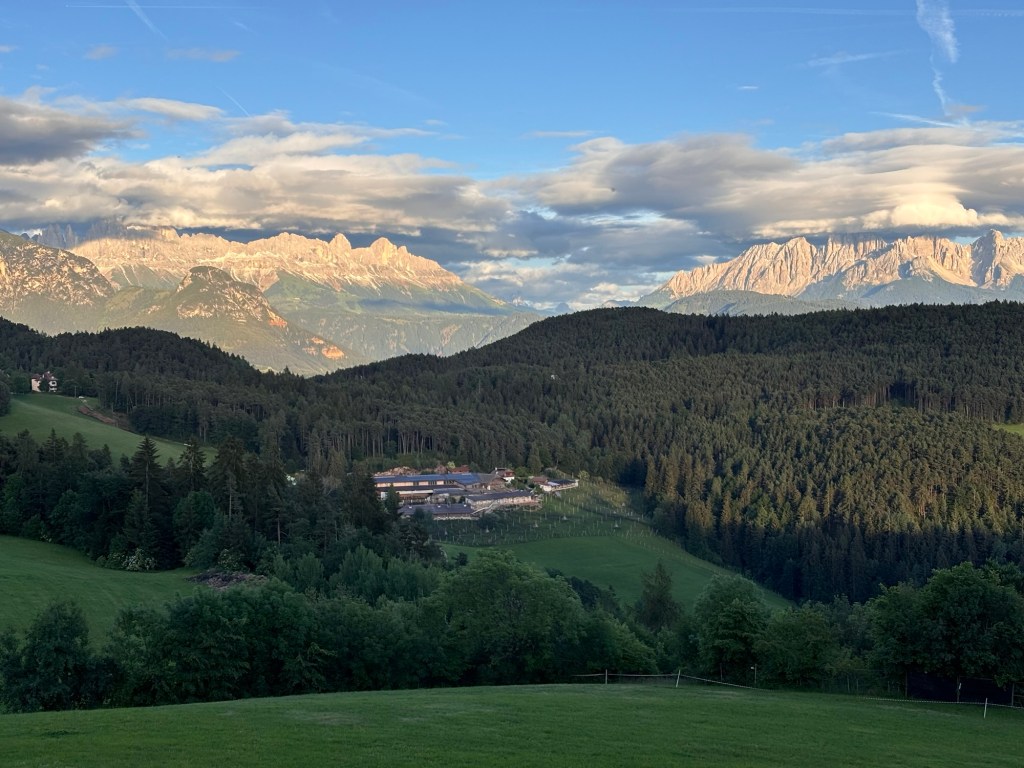
The church bells in Oberbozen ring at mostly random times, never on the hour and occasionally on a particular set of minutes. They ring regularly at 7:10 and 7:22 in the morning and then throughout the day at varying times. The bells have been a source of amusement over the five days we spent here in this northern Italian town that feels more like Austria than Italy. After 10 days in Bologna, Cremona and Parma – the “classic” Italy, with its renaissance art, grandiose cathedrals, and windy cobblestoned old town – this piece of northern Italy in the Dolomites, feels dramatically different. The landscape is indeed dramatic, which looks like an AI generated background for a movie scene; but I assure you – this is the real thing.
The view from Oberbozen
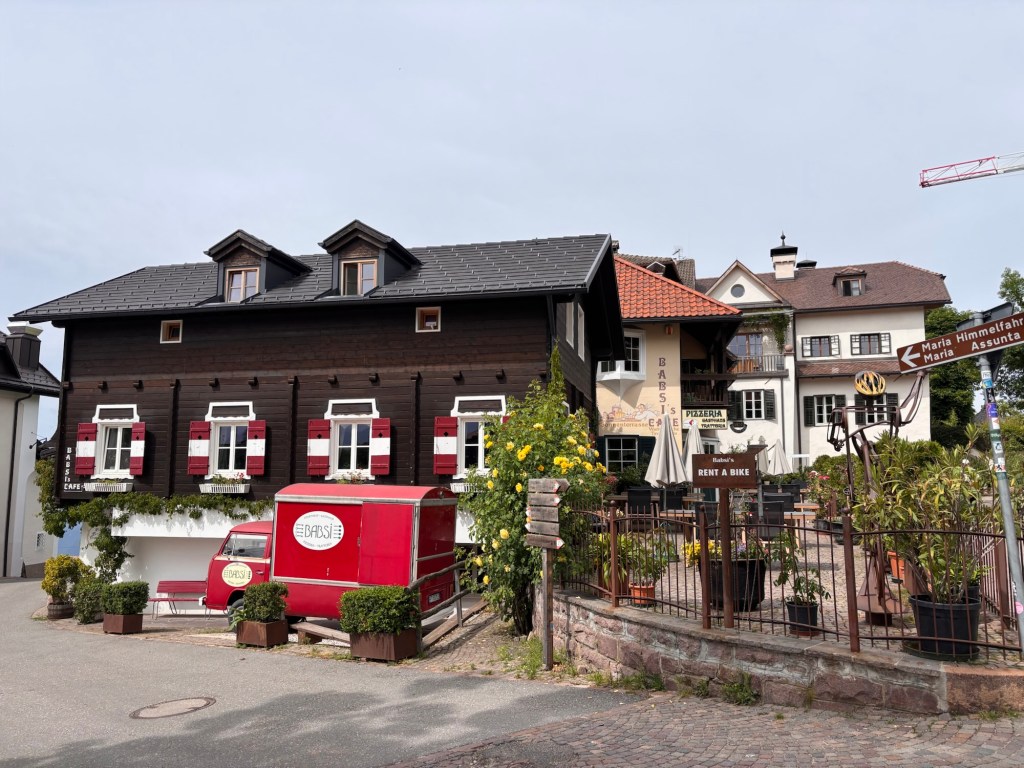
Oberbozen (in German) or Soprabolzano (in Italian) was our base for exploring this area. We feel fortunate to have chosen this spot – 1220 metres high – sitting “above” Bozen/Bolzano, the larger, fancier city below. It’s been a place to rejuvenate. Just over 1000 people live in Oberbozen, which feels like a close-knit small town. We stayed at the Gasthaus Babsi – owned and operated by the same family for 40 years. Mom settled us into our apartment, Dad helps tend bar, Philip, the older son runs the restaurant, and Benjamin is in charge of the guesthouse and also helps out in the restaurant. Philip makes everyone feel welcome, as if this restaurant is their restaurant. At the end of the meal, he offers everyone a shot of grappa or limoncello – on the house.
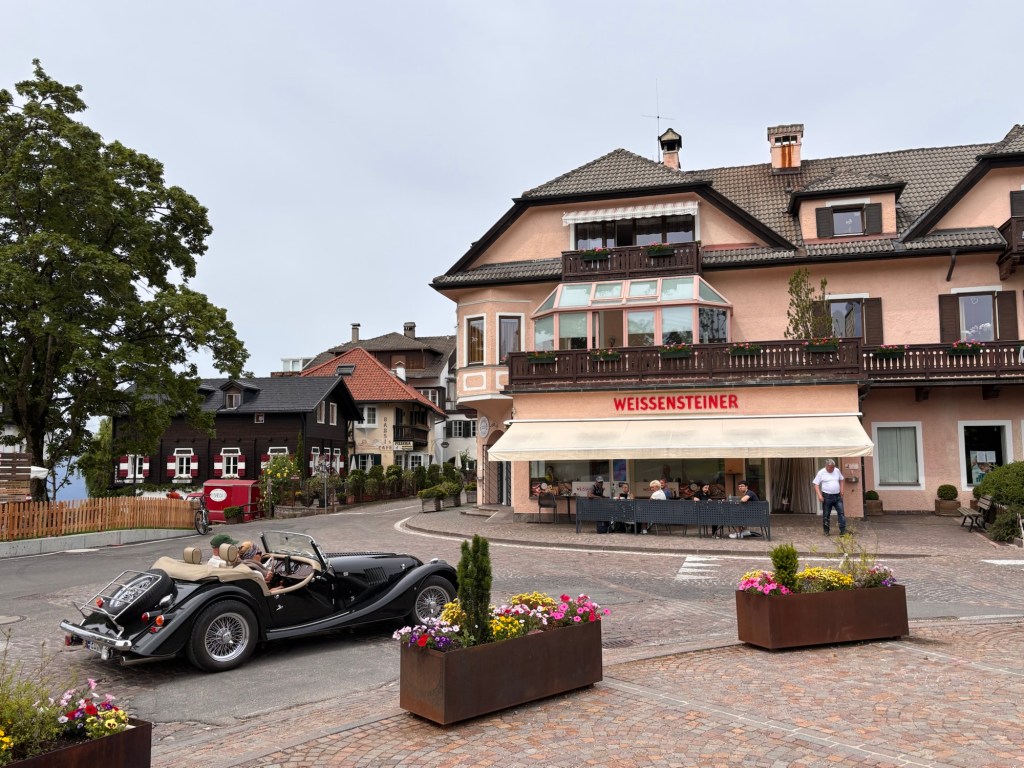
Across the street from the Babsi is the Weissensteiner butcher shop, which is much more than a place to get your meat. They offer up excellent pastries – the cheese danish was a big hit – and they brew up some fine cappuccinos. Need fresh bread, yogurt, fresh milk? Children’s books? They have you covered.
The Babsi GasthausWeissensteiner’s butcher shopOberbozen/ Soprabolzano
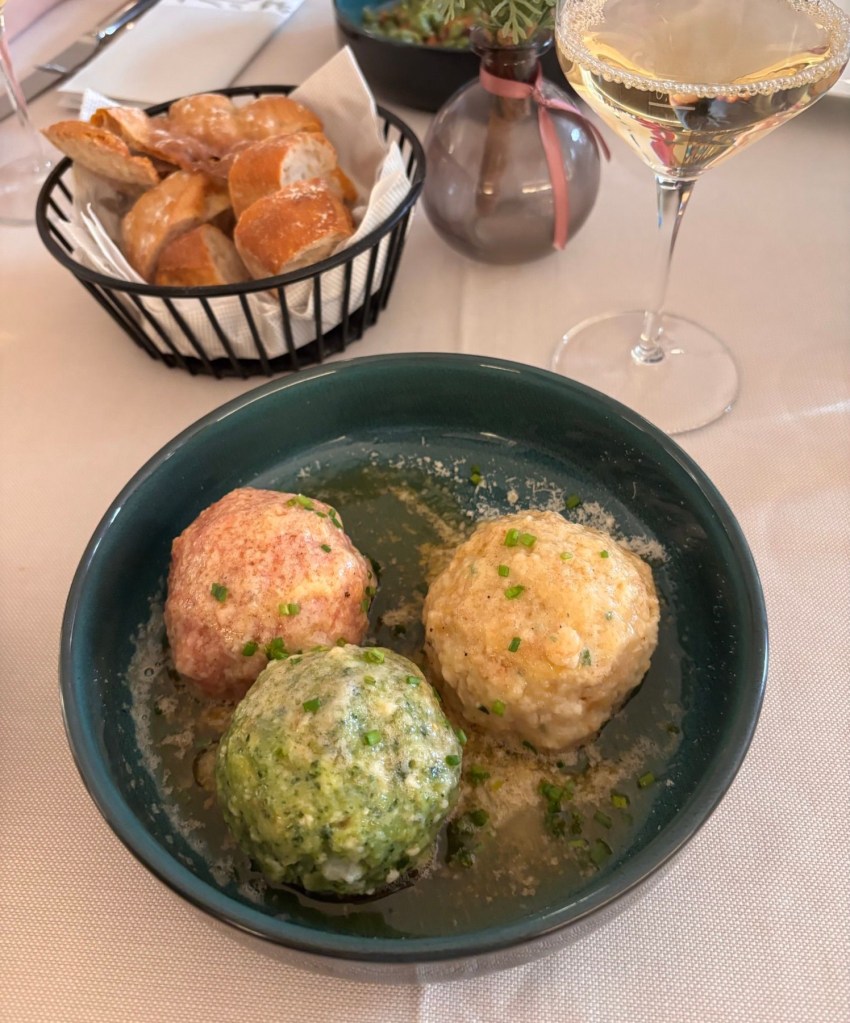
The Trentino-Alto Adige region, which borders Austria to the north, is home to a blend of people and culture. Here, all the signage is in German, Italian and sometimes Ladin, a Romance language unique to this corner of the world. In the province of Balzano that lies within the region of Trentino-Alto Adige – almost 70% of the population declare German as their native language. (This is good for me since my next best language after English is German). It is not uncommon to see men wearing lederhosen. The cuisine you find in restaurants might be filled pasta, like the kind you would find in Bologna, or spätzle, rustic egg and flour irregularly shaped dumplings commonly found in Austria and southern Germany, or knödel, large round bread dumplings – a südtirol specialty.
The modern history of this place reflects this back and forth between Italy and Austria. As part of the land trading that happened with the dissolution of the Austro-Hungarian Empire at the end of World War I, Italy annexed this area of South Tyrol. Later when Mussolini and Hitler formed their bond through fascism, and Hitler was directing Austrian politics, they gave the German speaking people in this area the choice to either move to Austria and continue to speak their language or stay in the region and learn to speak Italian. While walking the trails around here we saw way-marking signs with the Italian place names marked out with black paint – a reflection, perhaps, of the lingering bitterness of being forced to speak a language that is not your own.
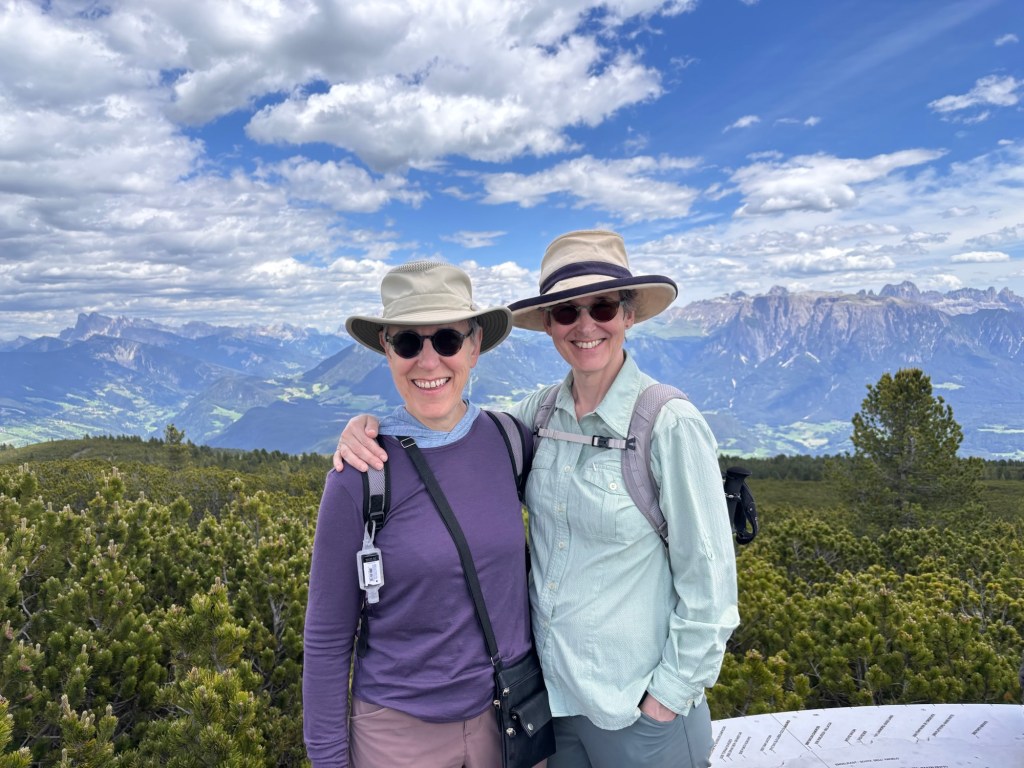
We added the Alto Adige area to our Italian itinerary because of its natural beauty and our interest in hiking. And it did not disappoint. The area is filled with hiking trails of all levels, from easy family walks to steep and technical climbs and descents. We chose “moderate” hikes on three of our days there. The most spectacular hike was a four hour trek across grassy meadows, through farmers’ fields, along rushing streams, following red and white way-marking signs up to Pemmern at 1538 metres above sea level. At the halfway point we stopped to refresh with our packed lunch of sandwiches, strawberries and one of the local wines we discovered – Lagrein. At Pemmern we caught the funicular up to Swarzseespitze, which sits at 2070 metres – where we found ourselves immersed in a semi circle of mountain peaks, a herd of bell-wearing goats nearby adding a soundscape. Here the trees are no more than 6 feet tall; we were just below where the tree line ends. The views, the views!
Sheila and me at 2070 metres in the Italian Alps
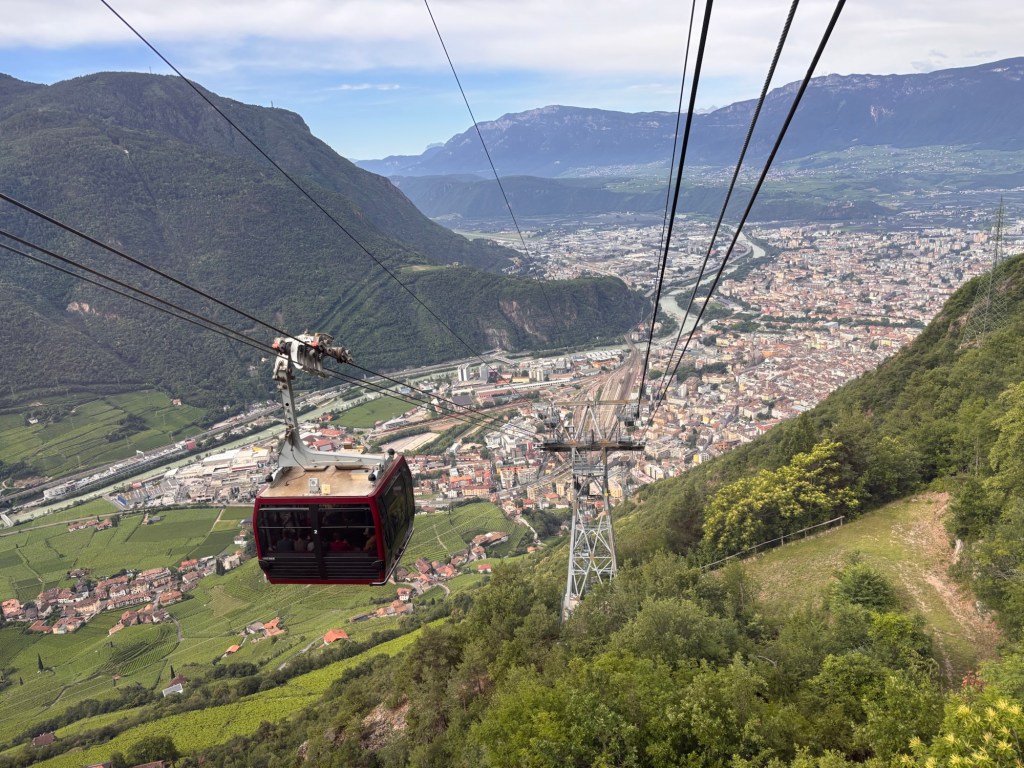
Of the 5 days we spent in this area, we spent just one day in Bozen/Bolzano. And that was enough. Bolzano is a very nice place to visit – with a charming old town filled with plenty of good restaurants, cafes, and an open market – but the quiet of the mountains was more of what we wanted than another city. So after a lunch of more spätzle and knödel (this would be our last), we took the funicular back up to our temporary home in Oberbozen for another restful night.
Funicular between Bozen and Oberbozen Knödel – beet, cheese and spinach
We loved our time in this northern corner of Italy. It was so very different than the other pieces of Italy we have come to know and love. And then, we were on the road again – by train to Innsbruck, Austria, just a sweet two hours away.